

Reviewed · WALKING TOURS
Innercity Walking Tour
Johannesburg rewards curious walkers. This four-hour inner-city walking tour moves beyond bus windows, linking creative districts, old markets, political landmarks, and gold-rush history. I like the close-up view of daily city life, and I like that the guide explains how to use Johannesburg’s public transportation. The main consideration is physical effort: you need moderate fitness, and part of the outing may use an air-conditioned vehicle or minibus.
The route also gives you places that many quick city tours skip, including Kwa Mai Mai Traditional Market and Collectors Treasury. At about $50.04 per person, it offers solid value if you want history, local context, and several distinct parts of central Johannesburg in one morning. The group can reach 20 people, so it may feel less personal than a private walk.
In This Review
- Key points to know before you book
- Why this Johannesburg walk is different
- Maboneng: Johannesburg’s Place of Light
- Kwa Mai Mai Traditional Market and local shopping
- Collectors Treasury, books stacked eight floors high
- Carlton Centre and the long view of Johannesburg
- Gandhi Square and the mining district
- Chancellor House and the Mandela and Tambo story
- Walking, minibus travel, and physical demands
- The guide is the heart of the experience
- Is $50.04 a fair price?
- Who should book this city walk?
- FAQ
- Where does the Innercity Walking Tour begin?
- What time does the tour start?
- Where does the tour end?
- How long does the tour last?
- What places are included?
- Is transport included?
- Are admission fees included?
- Is lunch included?
- How many people can join the tour?
- What fitness level is required?
- Can I cancel for a refund?
Key points to know before you book
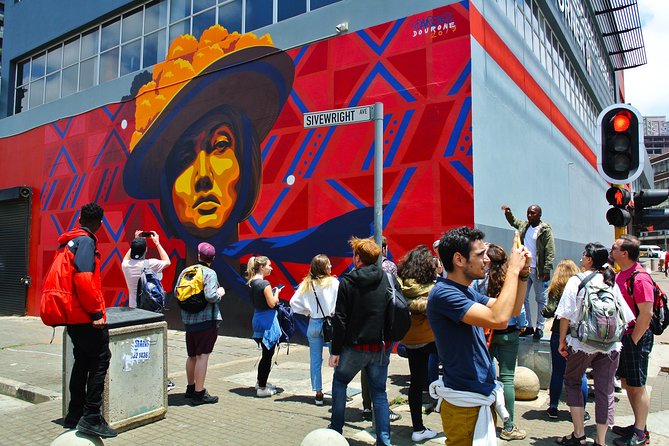
- Maboneng begins the story: See how art, design, and small businesses helped change a district once viewed as unsafe.
- Kwa Mai Mai is a practical souvenir stop: Browse traditional medicines, clothing, beads, walking sticks, crafts, and other locally made items.
- Carlton Centre brings the big view: Spend an hour hearing how Johannesburg grew from the 1886 gold rush through decades of decline and renewal.
- Mandela and Tambo’s legal history matters: Chancellor House connects the city walk to South Africa’s struggle for equality.
- The route mixes walking with transport: You will be on foot, but the experience also includes an air-conditioned vehicle and may include a minibus.
- The guide makes the difference: Past guests gave special praise to guides Thepso and Brite for their warmth, local insight, and ability to show less familiar places.
Why this Johannesburg walk is different
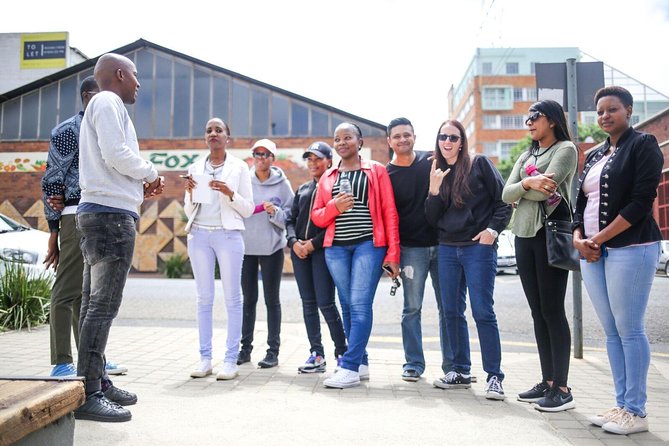
Johannesburg can be hard to read from a moving vehicle. Major roads, tall buildings, old mining structures, new cafés, street art, and busy public spaces pass by before you can connect them.
This tour slows the city down. You walk from place to place, pause to hear the story behind each district, and get a better sense of how central Johannesburg has changed. You are not simply checking off monuments. You are learning how the city fits together.
That matters here because Johannesburg’s past and present sit close to each other. A creative precinct can be near an old market. A modern city square can recall Gandhi. A modest office building can connect directly to Nelson Mandela and Oliver Tambo.
The guide also helps you understand public transportation. That is useful beyond this four-hour outing, especially if you want to continue exploring independently. You get a basic lesson in moving around the city rather than remaining behind the glass of a sightseeing bus.
The tour begins at 10:00 a.m. at 302 Fox Street in Jeppestown and returns to the same meeting point. Since the route lasts about four hours, plan to eat beforehand or carry money for refreshments. Lunch and drinks are not included.
More Walking Tours in Johannesburg
- Soweto: Walking Tour with a Local Guide and Lunch
★ 4.9 · 648 reviews - Soweto Walking Tour with Lunch
★ 5.0 · 288 reviews - Johannesburg: Local Food Tasting Guided Walking Tour
★ 4.7 · 192 reviews
Maboneng: Johannesburg’s Place of Light
Maboneng is the natural opening for this route because it shows Johannesburg in the middle of change. The name means Place of Light, and the district has become a center for artists, designers, and entrepreneurs.
You can expect about 45 minutes here, with admission included. The focus is not just on street art or attractive buildings. The guide explains how art became part of an effort to renew an inner-city area that had once been widely viewed as a no-go zone.
I like this stop because it gives you a useful warning about Johannesburg: the city cannot be reduced to either decline or revival. Maboneng contains both parts of the story. Its creative energy is real, but the tour’s value comes from hearing how and why that energy appeared.
You will likely have time to look around, take photographs, and notice details you would miss from a bus. The stop also helps you understand why walking is important here. You can see how public spaces, shops, art, and older urban structures sit together.
The drawback is that 45 minutes is enough for an introduction, not a full visit to every part of the precinct. If you want a long meal, extended shopping, or a slow art-focused afternoon, you would need to return on your own.
Kwa Mai Mai Traditional Market and local shopping
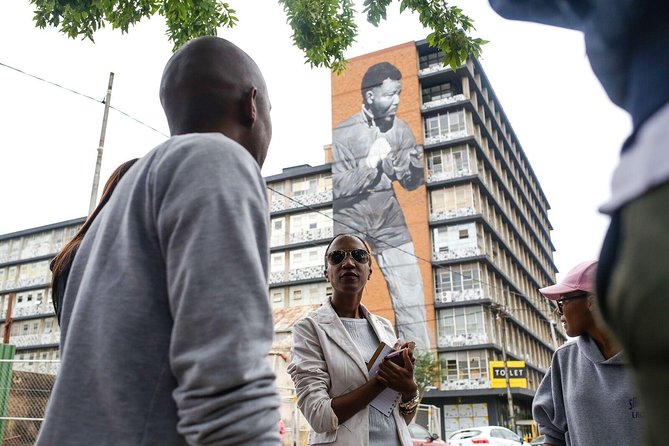
The next stop takes you to one of Johannesburg’s oldest markets. Kwa Mai Mai began as an old horse stable and now contains more than 176 stalls.
You have about 30 minutes here. That is a short visit, but it gives the market a clear purpose within the tour. You can browse traditional medicines, African clothing, beaded goods, artifacts, walking sticks, and craftwork.
This is one of the most useful places on the route if you want to take home something connected to South Africa rather than a generic souvenir. The market gives you a chance to see goods that relate to local traditions and everyday commerce.
I would keep your shopping expectations sensible. Thirty minutes will not allow you to inspect every stall, compare every item, and linger over long conversations. It is better to treat the stop as a first look, with the option of returning later if you find something you want to explore more carefully.
The market also adds texture to the day. After Maboneng’s creative and design-centered identity, Kwa Mai Mai shows another side of the city, one based on long-running trade, traditional items, and practical shopping.
Collectors Treasury, books stacked eight floors high
Collectors Treasury is a quick but unusual stop. The business occupies an eight-story building and is described as the largest second-hand bookstore in the Southern Hemisphere.
You have 15 minutes inside. Books are stacked throughout the building, along with LPs, maps, porcelain, and postcards. Even if you are not a serious book collector, the setting gives the walking tour a welcome change of pace.
Fifteen minutes is not enough to browse eight floors properly. That is the obvious limitation. If old books, records, maps, or postcards interest you, you may wish you had more time.
Still, this stop works well as a snapshot. It introduces a place with a distinctive character and shows that Johannesburg’s inner city is more than office towers and political landmarks. I would note the name and consider returning separately if you want to shop.
A completely different kind of day out on the same trip:
- From Johannesburg: Pilanesberg Nature Reserve Game Safari
★ 4.8 · 1,327 reviews - Johannesburg: Hop-On Hop-Off Bus with Optional Soweto Tour
★ 4.6 · 985 reviews - Soweto /Johannesburg and Apartheid Museum Guided Full Day Tour
★ 5.0 · 932 reviews - Johannesburg Hop-On Hop-Off City Tour with Soweto Option
★ 4.5 · 768 reviews
Carlton Centre and the long view of Johannesburg
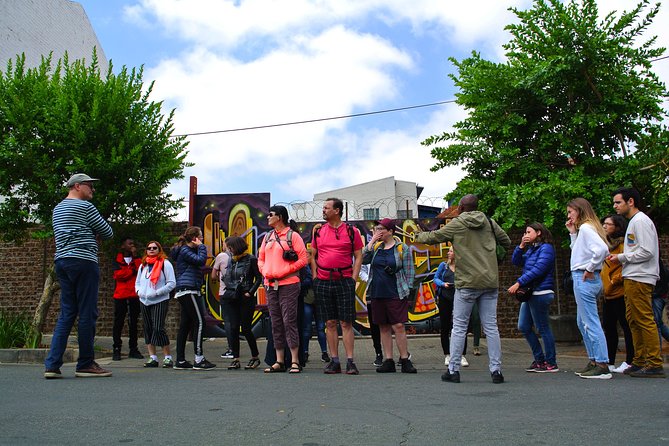
The Carlton Centre is the route’s longest stop, with about an hour devoted to the building and the city view. Built between 1969 and 1976 by the American architectural firm Skidmore, Owings and Merrill, it rises 223 meters above Johannesburg.
From this height, the guide places the city’s development in order. You hear about the 1886 gold rush, the period of urban decline during the late 1980s and 1990s, and the current effort to renew the city center.
This is where the tour’s separate stops begin to make sense. The market, the creative district, the mining area, and the older commercial center are not isolated sights. They are parts of a city shaped by gold, migration, business, politics, and major social change.
I especially like the amount of time allowed here. A quick photo stop would not do the Carlton Centre justice. An hour lets you take in the view while listening to the wider story.
You should also keep your expectations precise. The supplied details promise panoramic city views and historical narration, but they do not specify weather conditions or exactly how long you will spend at the viewing area itself. On a clear day, the height should make this one of the most memorable parts of the route, but visibility can affect any high-level city view.
Gandhi Square and the mining district
Gandhi Square receives about 20 minutes. It is named for Mahatma Gandhi, who spent 21 years in South Africa and operated his law firm in downtown Johannesburg.
The stop is brief, but the subject is important. Gandhi’s South African years shaped his political thinking, and the square connects that earlier period to the city’s Indian community and wider human rights history.
After Gandhi Square, you walk through the Main Street mining district toward Chancellor House. This transition is valuable because it turns the city itself into the historical setting. You are not moving from one unrelated attraction to another. The streets and buildings help connect Johannesburg’s mining wealth to its political past.
The short time at Gandhi Square may feel limiting if you want a long historical talk or quiet photography. Still, it is a useful pause before the tour reaches its most politically significant stop.
Chancellor House and the Mandela and Tambo story
Chancellor House is a modest three-story building with an outsized place in South African history. In the 1950s, it housed Mandela and Tambo Attorneys, described as South Africa’s first black-owned law firm.
You have about 30 minutes here. The building gives the guide a focused place to discuss Nelson Mandela and Oliver Tambo as working lawyers, not only as famous political figures.
Across from the former office is the Shadow Boxing Sculpture. Artist Marcos Cianfanelli based it on a well-known Bob Gosani image of a young Mandela boxing. The sculpture adds a visual link between Mandela’s personal life, public image, and the city where he practiced law.
This stop is a strong reason to choose the tour over a simple city-center walk. It places major historical events in an ordinary urban building. You can better appreciate how political work happened in offices, streets, and legal practices, not only in grand government halls.
The tour ends back at the Jeppestown meeting point. Because the route covers six stops and returns to its starting place, you do not need to arrange a separate pickup at the end.
Walking, minibus travel, and physical demands
The experience is promoted as a walking tour, and walking is central to it. You move through several inner-city areas rather than viewing everything from a coach.
At the same time, an air-conditioned vehicle is included, and one detailed account describes the outing as a combination of walking and personal minibus travel. That means you should not assume every minute is on foot. If you strongly prefer a fully walking route, ask about the transport portion before booking.
You should have moderate physical fitness. The tour lasts around four hours, includes several walking sections, and takes place across an urban route with multiple stops. Wear comfortable shoes and avoid planning another physically demanding activity immediately afterward.
The maximum group size is 20. That is not a tiny group, but it is manageable for a city walk if the guide handles the pacing well. A larger group can make questions and conversation harder, especially in busy streets.
The guide is the heart of the experience
The strongest praise centers on the guides. Thepso is described as accommodating and well informed, while Brite is praised for being friendly, cheerful, and able to show unusual places that a visitor might not find alone.
Those details matter more than polished transport or a long list of stops. Inner-city Johannesburg requires explanation. A good guide helps you understand what you are seeing, how the neighborhoods changed, and how to move through the city with greater confidence.
The guide also provides in-depth commentary during the walk. That turns the route into a lesson in urban history rather than a series of photo opportunities.
The experience has a 4.9 rating from 46 evaluations, with 98 percent recommending it. Those numbers point to a consistently strong experience, but they do not remove the practical limits: the group may reach 20 people, some stops are short, and the transport mix may not suit someone seeking a pure walking outing.
Is $50.04 a fair price?
At $50.04 per person, this is not the cheapest way to see Johannesburg. It is also more than a casual stroll through one neighborhood.
The value comes from the range packed into four hours. You receive guided visits to Maboneng, Kwa Mai Mai, Collectors Treasury, the Carlton Centre, Gandhi Square, and Chancellor House. Fees and taxes are included, and transport support is part of the experience.
You are paying for access to places that can be difficult to connect on your own, plus the historical explanation that ties them together. The price makes the most sense if you want a structured first look at central Johannesburg and plan to keep exploring afterward.
It is less compelling if you only want street art, shopping, or a single viewpoint. In that case, a focused visit may give you more time at one place. Lunch and refreshments are not included, so budget for those separately.
Free cancellation is available if you cancel at least 24 hours before the 10:00 a.m. start time. Changes or cancellations made within 24 hours are not accepted for a refund.
Who should book this city walk?
I would recommend it to first-time visitors who want context before exploring Johannesburg independently. It suits people who prefer real streets, local markets, and history over a purely panoramic sightseeing circuit.
It is also a good fit for travelers interested in South Africa’s political past, especially the Gandhi Square and Chancellor House sections. Readers who enjoy urban renewal stories will get the most from Maboneng and the Carlton Centre.
You may want to choose another experience if you dislike walking, want a private guide, or need a very relaxed schedule. The six-stop route covers a lot, and the short visits at Kwa Mai Mai, Collectors Treasury, and Gandhi Square leave little room for lingering.
Book this tour if you want a broad, guided introduction to Johannesburg’s inner city, with enough local detail to help you return to certain places later. Skip it if your priority is a slow, single-neighborhood visit. For most curious visitors, the combination of street-level access, strong guiding, and historical range makes the $50.04 worthwhile.
FAQ
Where does the Innercity Walking Tour begin?
It begins at 302 Fox Street, Jeppestown, Johannesburg, 2043, South Africa.
What time does the tour start?
The tour starts at 10:00 a.m.
Where does the tour end?
The activity ends back at the meeting point in Jeppestown.
How long does the tour last?
The tour lasts approximately four hours.
What places are included?
The route includes Maboneng Precinct, Kwa Mai Mai Traditional Market, Collectors Treasury, Carlton Centre, Gandhi Square Precinct, and Chancellor House.
Is transport included?
Yes. An air-conditioned vehicle is included. The experience also involves walking, and one account describes part of the route as using a minibus.
Are admission fees included?
Yes. All fees and taxes are included, and the listed stops include admission.
Is lunch included?
No. Lunch and refreshments are not included.
How many people can join the tour?
The maximum group size is 20 people.
What fitness level is required?
You should have a moderate level of physical fitness because the experience includes walking through Johannesburg’s inner city.
Can I cancel for a refund?
Yes. You can cancel at least 24 hours before the local start time for a full refund. Cancellations or changes made less than 24 hours before the start are not accepted for a refund.
Newest reviews from Johannesburg
- Cradle of Humankind and Maropeng Day Tour from Johannesburg★ 4.0 · 5 reviews
- Explore Soweto 8 Hour Tour with Lunch and Museum Visit★ 5.0 · 5 reviews
- 3 Day All Incl. Private Kruger Park Safari Incl. Transfer From Johannesburg★ 5.0 · 5 reviews
- Harties cableway Tour★ 4.5 · 5 reviews
- Pretoria Historical Tour★ 4.0 · 5 reviews
- Constitutional Hill and Soweto 5 hours tour.★ 5.0 · 5 reviews
- 5 Day Kruger National Park and Panorama Route Safari★ 4.5 · 5 reviews
- Luxury Car Johannesburg Airport Private Transfer★ 5.0 · 5 reviews
Walking Tours, compared.

Soweto: Walking Tour with a Local Guide and Lunch
Read our review →




Browse the lists this tour appears in