
Reviewed · STREET ART
Johannesburg: Maboneng Street Art & Culture Tour
Art tells Joburg’s story. This two-hour walk through Maboneng and nearby Jewel City pairs striking murals with the people, politics, and urban change behind them. I especially like the Hallmark House rooftop opening, which gives you an instant sense of Johannesburg’s scale, and the chance to meet local artists and vendors rather than simply photograph painted walls. The main drawback is that this is a walking tour in an inner-city area where you will want to stay close to your guide and follow local safety advice.
I also like the tour’s human touch. Guides such as Refiloe, Mulalo, and Clement have been praised for explaining artists in clear, personal terms, taking photographs, and suggesting places to eat or continue exploring. At $37 per person, the price is fair if you value context and local company, though art fans expecting a long gallery visit may find two hours goes by quickly.
In This Review
- Key points to know before you book
- Why Maboneng makes a useful introduction to Johannesburg
- Starting above the city at Hallmark House
- Reading the walls in Maboneng Precinct
- A quick stop at The Cosmopolitan Lounge
- Hallmark House, Access City, and Artisan Lofts
- Jewel City and the story of urban renewal
- Finishing around 264 Fox Street
- How safe and comfortable will you feel?
- The guides are the real strength
- Is $37 good value for two hours?
- Who should book this walk?
- Practical tips for making the most of it
- Should you book the Maboneng Street Art and Culture Tour?
- FAQ
- Where does the Maboneng Street Art and Culture Tour start?
- How long does the tour last?
- What language is the tour conducted in?
- What is included in the price?
- Are hotel pickup and drop-off included?
- Are food and drinks included?
- Which places does the tour visit?
- Can I cancel for a full refund?
Key points to know before you book
- The rooftop sets the scene: Begin at Hallmark House for broad city views before walking into Maboneng’s street-art districts.
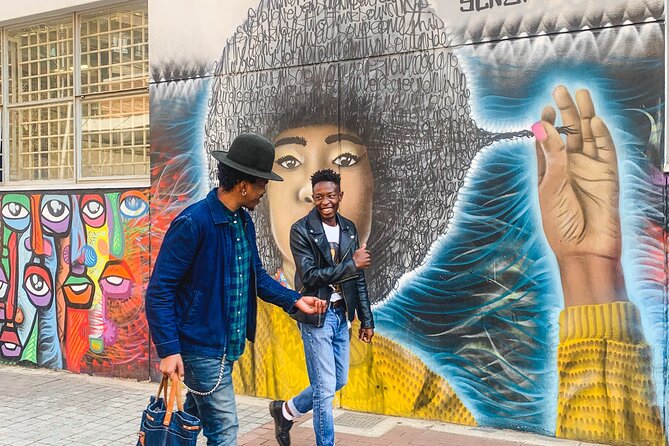
- Murals come with meaning: Your guide explains identity, resistance, hope, artists, techniques, and the post-apartheid city behind the images.
- You meet people, not just painted walls: Stops can include local vendors, creative spaces, galleries, and artists.
- The route covers several connected areas: Maboneng, Hallmark House, Access City, Artisan Lofts, Jewel City, and 264 Fox Street all feature in the walk.
- Safety comes from local guidance: Many participants felt comfortable with guides who know the area and are recognized by people nearby.
- It suits curious walkers: The tour is best for visitors who want art, urban culture, and history in one compact outing.
Why Maboneng makes a useful introduction to Johannesburg
Johannesburg can feel hard to read at first. Its districts carry different identities, and the city’s mining origins, apartheid-era separation, and post-apartheid changes are not always obvious from a car window.
Maboneng gives you a more direct way in. The precinct has become associated with art, design, food, small businesses, and new ideas about inner-city life. At the same time, it is not a polished theme park. You see creative renewal alongside the pressures and contradictions of a major South African city.
That tension is part of the value. The murals are not merely decoration. They can express pride, anger, memory, belonging, resistance, and hope. A good guide helps you see those layers instead of treating the neighborhood as a backdrop for photographs.
I would choose this tour early in a Johannesburg stay. The guide can help you understand the city’s cultural mood, and several guides have offered useful suggestions for restaurants, artists, drinks, and places to visit after the walk.
A few more tours worth putting side by side
- From Johannesburg: Pilanesberg Nature Reserve Game Safari
★ 4.8 · 1,327 reviews - Johannesburg: Hop-On Hop-Off Bus with Optional Soweto Tour
★ 4.6 · 985 reviews - Soweto /Johannesburg and Apartheid Museum Guided Full Day Tour
★ 5.0 · 932 reviews
Starting above the city at Hallmark House
The meeting point is inside Hallmark House at the coffee shop if you arrive before the tour begins. The listed starting address is 54 Siemert Road, so give yourself enough time to find the building and settle in before the appointed start.
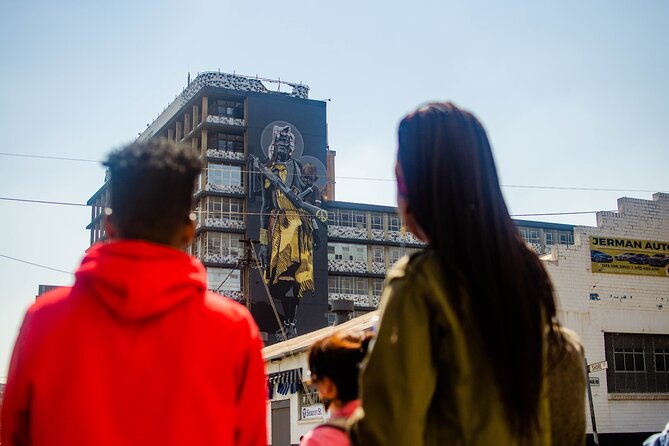
The tour begins on the Hallmark House rooftop, one of the city’s popular spots for views and sunsets. From up here, you get a broad look at Johannesburg before moving into the streets below. That first pause matters because it gives you a sense of the city’s size and density.
Your guide can use the view to introduce Johannesburg’s mining roots and the way the inner city has changed since apartheid. You are not just looking at buildings. You are getting an opening lesson in how a city shaped by gold, migration, segregation, and reinvention continues to change.
The rooftop is also a practical start. You can meet your guide, get oriented, and ask questions before the walking portion begins. If you want photographs of the skyline, take them here, since the rest of the tour focuses more closely on walls, doorways, shops, and street life.
Reading the walls in Maboneng Precinct
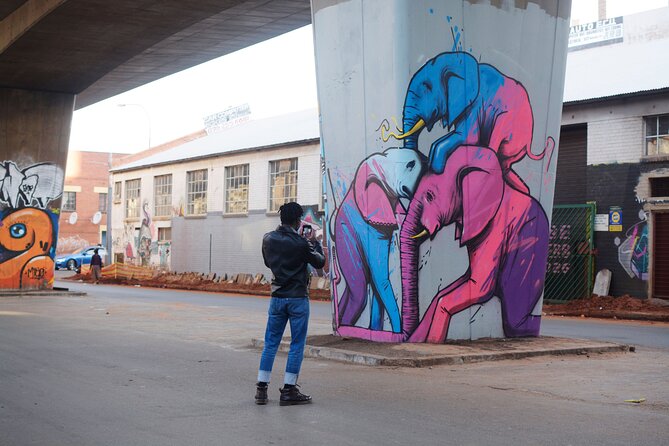
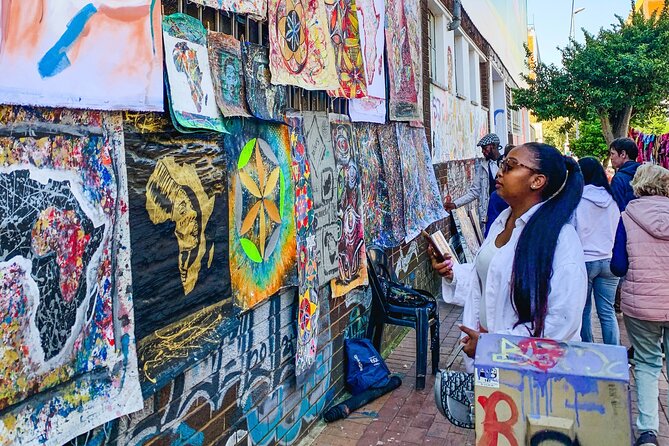
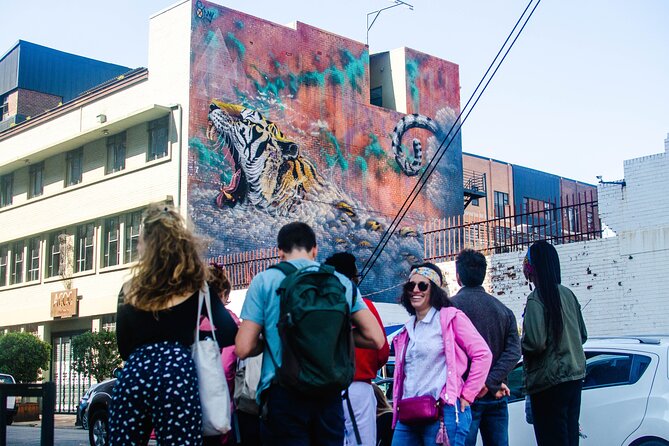
The first main stop is Maboneng Precinct, where the tour focuses on large-scale street art and smaller pieces woven into the district. You will pause for photographs, but the point is to understand what you are seeing.
Your guide discusses the artists, the stories behind the work, and the role murals play in changing how people view the inner city. You might hear about different styles and methods, along with the reasons a particular image matters in its setting.
This is where the quality of the guide makes the biggest difference. The artwork itself is easy to admire, but its meaning may not be obvious. A mural can look cheerful while carrying a political message, or appear abstract while referring to local identity and memory.
Refiloe has been praised for explaining each work with enthusiasm and personal insight. Mulalo has also received strong praise for connecting art with the area’s history and present-day changes. Clement was appreciated for his warmth and for introducing the wider culture of the neighborhood, not just the art.
You will likely see works in different styles and mediums. The precise pieces can change as walls are repainted, weathered, or replaced, so think of the tour as a guided reading of a living art scene rather than a fixed museum collection.
A quick stop at The Cosmopolitan Lounge
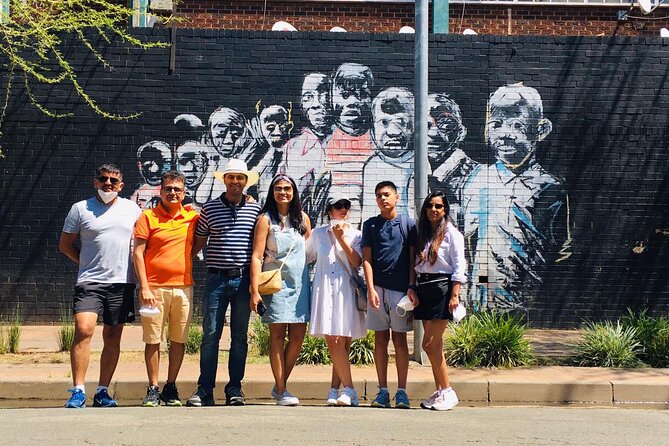
The Cosmopolitan Lounge is listed as a short five-minute stop. That tells you what to expect: a brief visit, photo opportunity, or passing look rather than a long meal or full bar experience.
Its value is in the rhythm of the walk. You move from public murals into places where Johannesburg’s social and creative life continues indoors. Your guide may point out how people use these venues and how they fit into Maboneng’s identity.
Do not book this tour mainly for food or drinks. They are not included, and the schedule does not promise a dedicated dining stop. If your guide recommends a place for later, write it down. That kind of local tip can be one of the useful extras of the afternoon.
A completely different kind of day out on the same trip:
- Johannesburg Hop-On Hop-Off City Tour with Soweto Option
★ 4.5 · 768 reviews - Full Day Ultimate Pilanesberg National Park Safari from Johannesburg or Pretoria
★ 4.5 · 718 reviews - Half-Day Tour of Soweto Tour
★ 4.5 · 712 reviews - Soweto: Walking Tour with a Local Guide and Lunch
★ 4.9 · 648 reviews
Hallmark House, Access City, and Artisan Lofts
The route returns to Hallmark House for another short visit that can include sightseeing, shopping, and walking. Hallmark House functions as more than a meeting point here. It is part of the creative and design-focused side of the district.
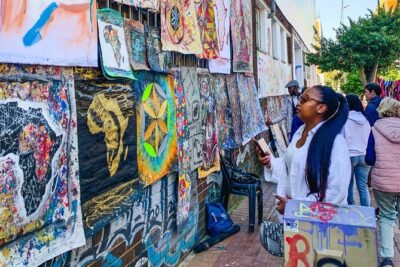
Next comes Access City, listed as a ten-minute stop with an arts and crafts market visit. This is a chance to see how creative work moves beyond walls and into objects you can browse or buy. Local vendors give the tour a more personal feel, especially if you take time to ask about what they make and sell.
Artisan Lofts adds another ten-minute market and creative-space stop. These shorter visits are useful for seeing the range of small-scale work in the area, but you should not expect the leisurely shopping time of a dedicated market tour.
I like this part because it keeps the experience from becoming a simple mural hunt. You see art as a working part of the neighborhood, connected to studios, stalls, galleries, and local enterprise. If you hope to shop, keep your expectations sensible and ask your guide when it is best to browse.
Jewel City and the story of urban renewal
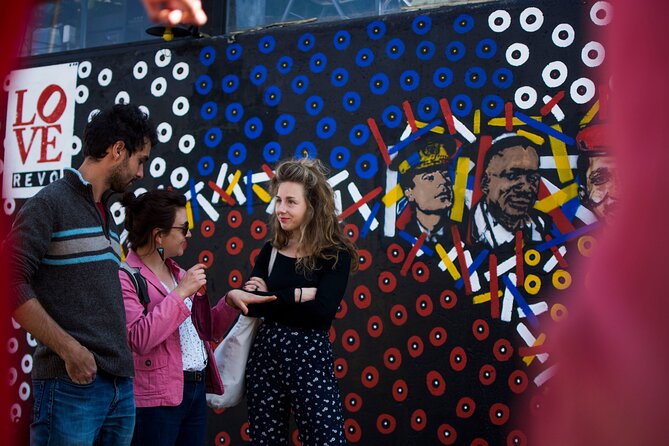
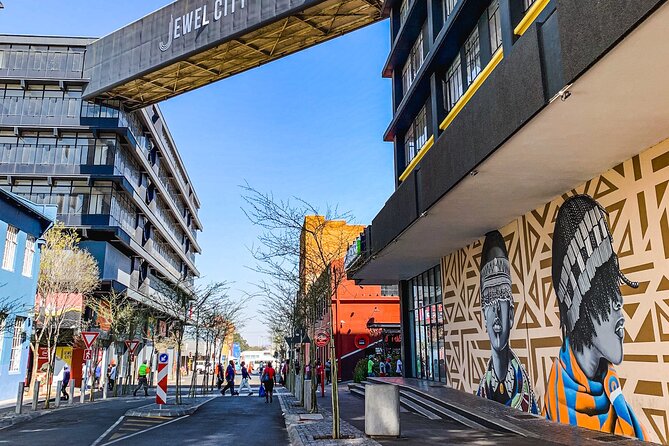
Jewel City is another major stop. The area reflects Johannesburg’s links to modern art and urban renewal, and the route can include galleries, vendors, creative spaces, and more street scenes.
Your guide explains emerging artists, their motivations, and the techniques they use to tell stories that work both locally and beyond South Africa. This is a good place to ask questions about how artists make a living, who commissions public work, and how new creative districts affect the people already living and working nearby.
Urban renewal can sound simple in a brochure. In practice, it raises difficult questions about access, ownership, opportunity, and who benefits when an inner-city area becomes fashionable. The tour offers a chance to consider those questions without reducing Johannesburg to either a success story or a warning.
Several people have enjoyed stopping at galleries and having enough time to browse. Still, the total tour lasts only two hours, so the gallery element is an introduction, not a full art-market afternoon. If one gallery or artist catches your eye, return after the tour with more time.
Finishing around 264 Fox Street
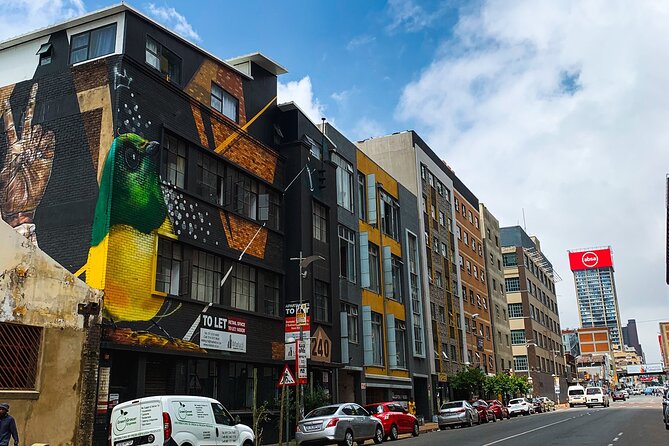
The final section takes you to 264 Fox Street, with sightseeing, street art, and a guided walk. This area helps bring the route back to the street, where art, businesses, and daily life sit close together.
The tour may finish with more discussion of the artists and the changes taking place around Maboneng. One especially appealing part of the experience is the possibility of meeting local creatives or learning where to find their work afterward.
The exact order and amount of time at each place can vary. The listed stops add up to less than two hours because the remaining time is spent walking, talking, crossing between areas, and pausing at artworks. That is worth remembering if you prefer a tightly timed attraction with a long stop at every location.
How safe and comfortable will you feel?
Safety is a central concern for many people considering an inner-city Johannesburg walk. The experience does not promise that the area is risk-free, and you should not treat a guided tour as permission to wander anywhere alone afterward.
What the tour does offer is local presence and guidance. Many participants felt safe because their guides knew the area, greeted people nearby, and kept the group together. Refiloe was repeatedly praised for making people feel at ease, while Mulalo and Clement were also described as reassuring and attentive.
Use ordinary city habits. Keep valuables out of sight, stay with the guide, listen when you are told where to walk, and avoid separating from the group for photographs. Wear comfortable shoes, since the route involves walking between several locations and standing at art stops.
The atmosphere can change from one street to the next. That is not a reason to avoid the tour, but it is a reason to value the guide’s local judgment. If you want a completely controlled environment, a museum would be a better fit. If you want to understand the city as it is lived, this format offers more.
The guides are the real strength
The strongest pattern across the experience is the guide’s role. Refiloe is frequently praised for his warmth, humor, passion for art, and ability to explain difficult subjects without making the walk feel like a lecture.
Mulalo has been singled out for his strong grasp of Johannesburg’s history, art, and current changes. Clement has been appreciated for making people feel welcome and for adding personal stories about the city and its districts.
Guide assignments can change, so you should not assume a particular person will lead your departure. The consistent benefit is the local perspective. You get explanations about artists and artworks that you would be unlikely to find on your own, along with practical suggestions for restaurants and further exploring.
Some guides also take photographs for participants. That is a pleasant extra, but the more important benefit is conversation. Ask questions. The walk becomes much more rewarding when you treat it as an exchange rather than a series of posed stops.
Is $37 good value for two hours?
At $37 per person, the tour is not the cheapest way to see public art. You could walk through parts of Maboneng independently without paying a guide.
The price begins to make sense when you add up what the guide contributes: an organized route, local context, explanations of artists, help navigating the district, introductions to creative spaces, and greater confidence while walking through an area that may feel unfamiliar.
I would call it good value for three kinds of people. First, art lovers who want meaning rather than photographs alone. Second, first-time Johannesburg visitors who need a clear introduction to the inner city. Third, independent explorers who want recommendations for where to continue after the tour.
It is less suitable if you want extensive shopping, a long gallery visit, food tastings, or private transport. Food and drinks are not included, and neither is hotel pickup or drop-off. You will need to reach Hallmark House yourself.
Who should book this walk?
You should consider it if you enjoy street photography, contemporary art, city history, architecture, and meeting local people. It also suits anyone who has spent much of a South African trip on safari and wants a compact urban outing with plenty of walking.
Families can take part, though younger children may not follow every historical or political discussion. One family with an 11-year-old enjoyed the route, which suggests the format can work well when children are comfortable walking and looking closely at art.
The tour is conducted in English, so you should be comfortable following a live discussion in that language. Solo visitors can also benefit, since the guide helps create a social and reassuring setting. One person even received a full, attentive experience when they were the only booking that afternoon.
You will get the most from it if you remain open to complexity. Maboneng is not presented as a perfect success story, and Johannesburg’s past includes painful divisions. The art becomes more powerful when you allow room for both progress and unresolved problems.
Practical tips for making the most of it
Arrive early and wait inside Hallmark House at the coffee shop if you are there before the start. That is the clearest meeting instruction, and it avoids confusion outside the building.
Wear shoes suitable for two hours on foot. Bring a phone or camera, but keep it secure and avoid letting photography distract you from the guide’s explanations.
Leave room in your schedule after the walk. You may want to return to a gallery, buy something from a market, follow a restaurant suggestion, or look up an artist you encountered. The tour gives you leads, but you will need extra time to follow them.
The activity offers free cancellation up to 24 hours before the start, and you can reserve now and pay later. Starting times vary, so check availability when booking.
Should you book the Maboneng Street Art and Culture Tour?
Book it if you want context, conversation, and a closer look at Johannesburg’s creative life. The murals are the hook, but the real reward is learning how art connects to identity, public space, urban renewal, and the city’s difficult past.
I would not choose it as your only Johannesburg experience. It does not replace a broader city tour, a museum visit, or time in other districts. But as a two-hour introduction to Maboneng, it offers strong value, thoughtful local guidance, and a safer way to approach an area you might otherwise struggle to read.
FAQ
Where does the Maboneng Street Art and Culture Tour start?
The listed starting location is 54 Siemert Road. If you arrive before the tour begins, wait inside Hallmark House at the coffee shop.
How long does the tour last?
The walking tour lasts two hours.
What language is the tour conducted in?
The live tour guide speaks English.
What is included in the price?
A guide is included.
Are hotel pickup and drop-off included?
No. You must make your own way to the meeting point, and hotel pickup and drop-off are not included.
Are food and drinks included?
No. Food and drinks are not included in the tour price.
Which places does the tour visit?
The route includes Maboneng Precinct, The Cosmopolitan Lounge, Hallmark House, Access City, Artisan Lofts, Jewel City, and 264 Fox Street.
Can I cancel for a full refund?
Yes. You can cancel up to 24 hours in advance for a full refund.
Newest reviews from Johannesburg
- Cradle of Humankind and Maropeng Day Tour from Johannesburg★ 4.0 · 5 reviews
- Explore Soweto 8 Hour Tour with Lunch and Museum Visit★ 5.0 · 5 reviews
- 3 Day All Incl. Private Kruger Park Safari Incl. Transfer From Johannesburg★ 5.0 · 5 reviews
- Harties cableway Tour★ 4.5 · 5 reviews
- Pretoria Historical Tour★ 4.0 · 5 reviews
- Constitutional Hill and Soweto 5 hours tour.★ 5.0 · 5 reviews
- 5 Day Kruger National Park and Panorama Route Safari★ 4.5 · 5 reviews
- Luxury Car Johannesburg Airport Private Transfer★ 5.0 · 5 reviews
Street Art, compared.



Colours of Johannesburg: A Graffiti & Street Art Tour
Read our review →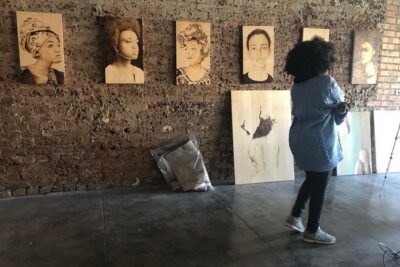
(Meet the Artist)Art Gallery & Street Art tour with lunch
Read our review →
Johannesburg Street Art & Museum Walking or E-scooter Tour
Read our review →Browse the lists this tour appears in