
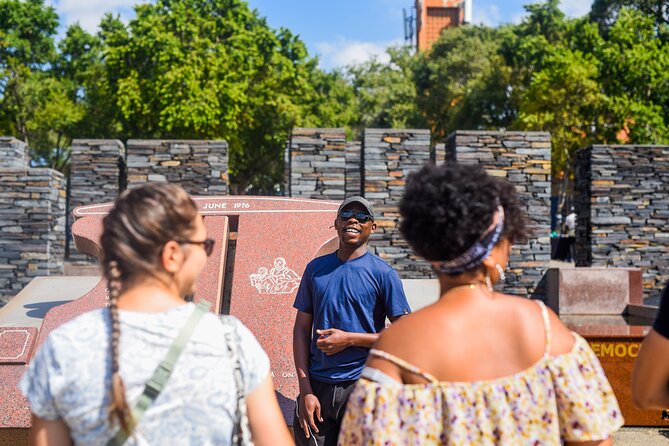
Reviewed · SOWETO TOURS
Guided Bicycle Tour of Soweto with Lunch
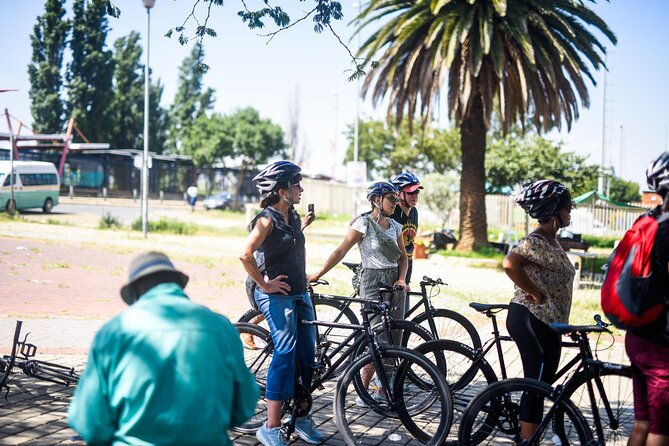
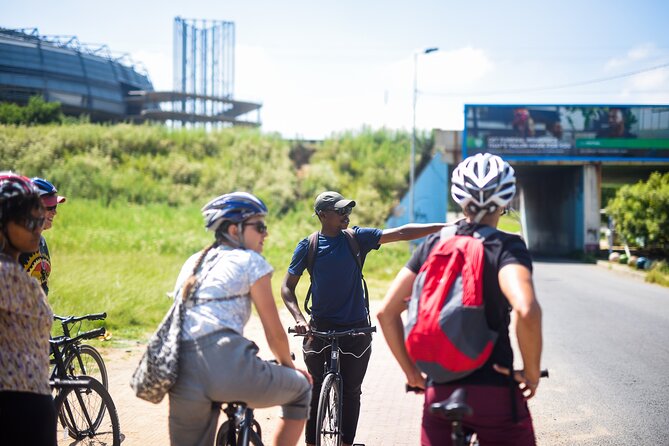
Soweto tells its story best from the street. I like the way this four-hour bicycle tour reaches places a walking outing would struggle to cover, from Vilakazi Street to Mzimhlophe’s former women’s hostel. I also like the focus on women such as Lillian Mgoyi, whose role in the anti-apartheid struggle is too often left out. The main catch is physical: Soweto has plenty of hills, and some bikes have been single-speed.
You’ll also get a kota sandwich lunch, bottled water, a bicycle, and a helmet for $45.70. That is a fair price for a small-group outing capped at 15 people, especially since the guide, food, and equipment are included. Do not expect a quiet museum tour on wheels, though. You’ll ride on ordinary township streets, work your legs, and need to stay alert.
The guides make a big difference. Themba, Thabo, Thato, Temba, Mulalo, and Murulla Mohuma are praised for being friendly, flexible, careful, and clear when explaining Soweto’s past. The result is a personal introduction to the community, not just a checklist of famous names.
In This Review
- Key points to know before you book
- Why a bicycle is a smart way to see Soweto
- Starting in Phomolong with a family view of apartheid
- Mzimhlophe and the women who worked in Johannesburg
- Lillian Mgoyi’s home and the women’s march
- Hector Pieterson and the 1976 youth uprising
- Orlando Stadium, football, and township identity
- Mandela House and Vilakazi Street
- The unnamed police stop needs clarification
- Kota lunch: a proper township meal
- Guides, group size, and the feel of the ride
- How hard is the cycling?
- Price, transport, and cancellation
- Who will enjoy this Soweto bike tour?
- Should you book it?
- FAQ
- How long does the Soweto bicycle tour last?
- Where does the tour begin and end?
- Is lunch included?
- Is entry to Mandela House included?
- Are bicycles and helmets provided?
- Can I cancel for a full refund?
Key points to know before you book

- A moving lesson in apartheid history: Visit the Hector Pieterson Museum area and hear how the 1976 youth uprising changed South Africa.
- Women’s stories receive proper attention: Mzimhlophe and Lillian Mgoyi’s former home bring domestic workers and women activists into the center of the tour.
- Vilakazi Street packs in major history: See the street connected with Nelson Mandela and Desmond Tutu, two Nobel Peace Prize winners who lived there.
- Expect hills and exercise: The ride is manageable for many casual cyclists, but single-speed bikes can make the climbs tiring.
- Lunch is local and filling: The kota is a deep-filled township sandwich, closer to a full meal than a light snack.
- Small groups help the conversation: With no more than 15 people, you have a better chance to ask questions and keep near the guide.
Why a bicycle is a smart way to see Soweto
Soweto is too large to understand from one famous street. A bicycle lets you connect the better-known landmarks with ordinary residential areas, sports grounds, memorials, and streets where daily life continues alongside major events from South Africa’s past.
I like the pace. You are close enough to notice houses, shops, sidewalks, children, and community life, but you cover more ground than you would on foot. The guide can stop, gather the group, and explain how apartheid affected families across generations.
That local scale matters. Soweto is not only a place of political landmarks. It is also a living township where people work, raise families, follow football, and greet a passing cycling group. The ride gives you a broader view than a quick photograph at Mandela House.
The tradeoff is comfort. This is not a smooth recreational cycle on a dedicated path. You’ll ride through the township and tackle repeated inclines. Some past participants found the single-speed bikes perfectly usable, while others wanted gears for the hills. Recent equipment updates reportedly added geared bikes, but I would still ask about the bike available on your date.
More Cycling Tours in Johannesburg
- Soweto: Guided Bicycle Tour with Lunch
★ 4.9 · 292 reviews - Soweto: Bike Tour with a Local Tour Guide
★ 4.7 · 114 reviews - Soweto Food & Beer Bike Tour
★ 4.9 · 40 reviews
Starting in Phomolong with a family view of apartheid
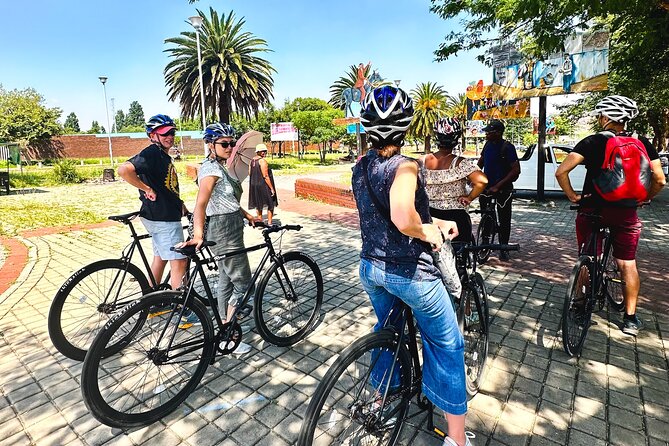
The tour begins at 7346 Kumalo Street in Orlando West and ends at the same meeting point. The first stop, Phomolong, sets the tone with stories about family generations, apartheid’s effect on ordinary people, and the changes Soweto has experienced since that era.
This is a useful opening because it moves the subject away from famous leaders alone. You begin with the wider social story: how laws and segregation shaped home life, employment, movement, and family choices. That background helps the later memorials make more sense.
The stop lasts about 15 minutes, so do not expect a full lecture. Instead, think of it as a guide-led orientation before the cycling begins in earnest. It gives you a framework for the streets around you.
Guides such as Themba and Thabo are praised for explaining the past with warmth and humor while keeping the human cost in view. That personal style seems to be one of the tour’s strongest features. You are encouraged to ask questions rather than simply follow a script.
Mzimhlophe and the women who worked in Johannesburg
Mzimhlophe offers one of the tour’s most distinctive stops: a former women’s residential hostel. It housed Black domestic workers employed in the suburbs of Johannesburg during apartheid.
The hostel helps explain a part of the system that can be missed at larger political sites. Domestic workers were separated from their families for work and faced restrictions that affected where they could live and how they could move. Seeing the type of place connected with that experience gives the subject a physical presence.
You spend about 30 minutes here, making it one of the longer stops. That is appropriate. The site calls for explanation and questions, and a quick bicycle-side pause would not do it justice.
I especially value this part of the route because it broadens the usual Soweto story. Nelson Mandela, Desmond Tutu, and the 1976 schoolchildren are essential subjects, but the fight against apartheid was also carried by women balancing work, family, protest, and state controls.
Lillian Mgoyi’s home and the women’s march
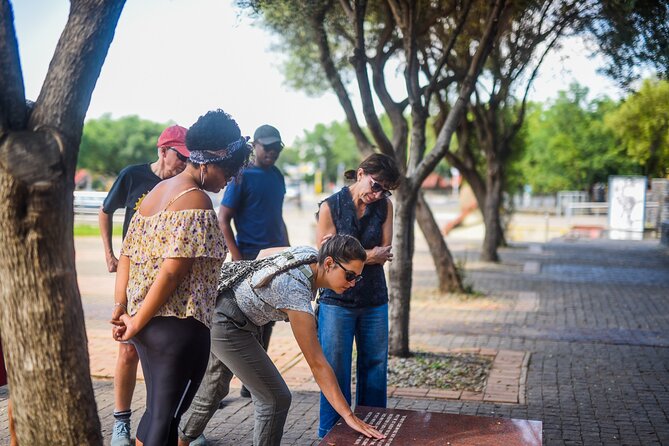
At Nkungu Street, the group visits the home of Lillian Mgoyi, also spelled Lilian Mgoyi in some references. She was an anti-apartheid activist and president of the Women’s League.
Her story is tied to the 1956 women’s march, when about 20,000 women went to the Union Buildings in Pretoria to protest the government’s pass laws and the requirement that women carry passbooks. The tour gives this event a physical setting by linking it to Mgoyi’s home.
The stop takes around 10 minutes. It is brief, but the subject is powerful. You’ll get more from it if you have already listened closely during the opening explanation at Phomolong.
This is the kind of detail that can make a tour worthwhile. A standard sightseeing route might mention the famous male leaders and move on. Here, the guide makes room for a woman whose organizing helped challenge apartheid directly. That is a meaningful improvement to the usual story.
More Soweto tours:
- Johannesburg: Hop-On Hop-Off Bus with Optional Soweto Tour
★ 4.6 · 985 reviews - Soweto /Johannesburg and Apartheid Museum Guided Full Day Tour
★ 5.0 · 932 reviews - Johannesburg Hop-On Hop-Off City Tour with Soweto Option
★ 4.5 · 768 reviews - Half-Day Tour of Soweto Tour
★ 4.5 · 712 reviews
Hector Pieterson and the 1976 youth uprising

The Hector Pieterson Museum and Memorial focuses on the 1976 youth uprising. The museum is named for Hector Pieterson, whose death became one of the defining images of the uprising.
The scheduled stop is about 30 minutes. The information provided for this tour does not include a separate museum admission charge, but it is wise to confirm exactly what access is included before you go. The route clearly takes you to the museum and memorial area, while entrance arrangements can vary.
This is one of the most important historical stops on the ride. The 1976 uprising began with student opposition to the forced use of Afrikaans in schools and grew into a major revolt against apartheid education and state control. The memorial helps connect those events to the young people who took part.
Expect the mood to become more serious here. The cycling and friendly street interaction do not erase the painful subjects. A good guide will help you place the events in context without reducing them to a single photograph or date.
Orlando Stadium, football, and township identity
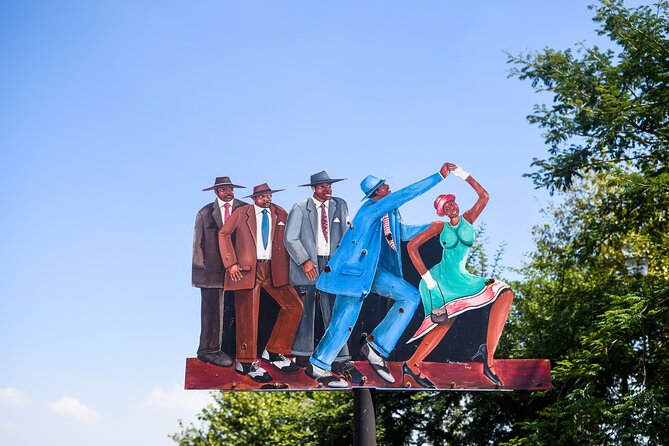
The route continues to Orlando Stadium, an important sports and community venue. The stadium dates to 1959 and was later demolished and rebuilt, with the newer structure holding more than 37,000 spectators.
Orlando Stadium is tied to Orlando Pirates, one of South Africa’s major football clubs. The stop shows another side of Soweto’s public life. Political history is central here, but football, concerts, and community gatherings also shape how people identify with the area.
You spend about 10 minutes at the stadium. Admission is not included, so the visit is an exterior or brief guided stop unless you arrange otherwise. The stadium can feel like a quick change of subject after the museum, but that contrast is useful. It shows Soweto as a place with a future and a daily culture, not only a memorial to oppression.
Mandela House and Vilakazi Street
Mandela House is the famous former home of Nelson Mandela. Entrance costs R60 and is not included in the tour price. If you want to enter, carry extra money and allow enough time for the visit.
The route also includes Vilakazi Street, where Mandela lived, and where Desmond Tutu also had a home. It is often described as the only street associated with two Nobel Peace Prize winners. You spend about 40 minutes in the area, making it a central part of the outing.
Vilakazi Street can feel more visitor-focused than the residential stops, but it is still an essential place to understand Mandela’s connection to Soweto. The nearby cafés and family-linked businesses add a personal layer. One guide-led outing began at an espresso shop owned by the grandson of the person after whom Vilakazi Street was named, giving the start of the day an appealing local connection.
The best approach is to see Mandela House as one piece of a larger route. If you only visit the house, you may leave with a narrow version of Soweto. After cycling through Phomolong, Mzimhlophe, Nkungu Street, and the museum area, the house has more meaning.
The unnamed police stop needs clarification
The itinerary includes an Orlando Police Department stop of about 10 minutes. The description supplied for this stop refers to the Orlando Police Department in Orlando, Florida, including details about American officers and facilities. Those details do not fit Soweto in Johannesburg.
That looks like a clear description error. I would not treat this as a major problem with the ride itself, but I would ask One Day Africa what the stop actually involves. It may be a simple pass-by, a local police-history reference, or an accidental piece of text from another activity.
This is one of the few points where the tour information needs checking. A quick message before booking can prevent confusion and help you understand the exact route.
Kota lunch: a proper township meal
Lunch is a local burger called a kota. This is a large, deep-filled sandwich associated with township food culture. It is designed to fill you up, not merely tide you over until dinner.
The meal is included, along with bottled water. The quantity is useful after several hills, and the food gives the tour a local flavor that a packaged snack would miss. Some outings have also included the chance to buy beer from Soweto Brewery, but extra drinks and purchases are not part of the stated inclusion, so budget separately.
I like the lunch break because it gives the group time to relax and talk with the guide. The ride combines difficult history with ordinary pleasures: food, conversation, football, and neighborhood streets. That mix feels more honest than treating Soweto as an outdoor museum.
If you have dietary restrictions, ask the provider before booking. No alternative meal information is supplied, so you should not assume the kota can be changed.
Guides, group size, and the feel of the ride
The guide is the heart of this experience. Themba receives repeated praise for being funny, attentive, flexible, and careful with the group. Thabo is described as welcoming and effective at making people feel safe. Thato, Temba, Mulalo, and Murulla Mohuma are also praised for local insight, patience, and a friendly approach.
Guides have adjusted the route for requests, allowed a relaxed pace when a group arrived late, and included teenagers in the conversation. Those details suggest a personal outing rather than a rigid procession from one stop to the next.
The group limit is 15 people. That is not private-tour size, but it is small enough for questions and easier cycling than a large convoy. You should still stay close to the guide and follow instructions at crossings and busy sections.
The community welcome is another strong point. People may wave or call hello as you pass. That does not mean you should photograph everyone or treat the neighborhood as a stage. Use ordinary courtesy, ask before taking close-up portraits, and listen when the guide explains local customs.
How hard is the cycling?
You need a reasonable level of comfort on a bicycle. The route includes hills, and several people describe it as a workout. Casual cyclists managed it, but the ride can be tiring on a single-speed bike.
The supplied equipment includes a bicycle and helmet. Some bikes have reportedly been upgraded with gears, which makes climbing easier, but equipment may vary. If hills worry you, ask in advance for a geared bike or explain your fitness level to the provider.
Wear sunscreen and bring a cap. That advice comes directly from the practical experience of people who completed the route. Bottled water is included, but you should still dress for outdoor activity and be ready to spend four hours exposed to the elements.
Morning and afternoon departures are available. Choose the cooler or more convenient time for your schedule, but remember that the tour still requires energy at either hour. If you want to combine it with another Johannesburg activity, the half-day format leaves room around it, provided you allow time to reach Orlando West.
Price, transport, and cancellation
At $45.70 per person, the tour offers solid value. You receive a guide, bicycle, helmet, water, lunch, and about four hours of sightseeing. The price does not include pickup or drop-off, the R60 entrance fee for Mandela House, or extra food and drinks.
You need to make your own way to 7346 Kumalo Street in Orlando West. The meeting point is near public transportation, but the supplied information does not specify a hotel transfer or a particular transit route. Plan that part before the day of the tour.
Confirmation is issued at booking, and most people book about 11 days ahead. Free cancellation is available up to 24 hours before the local start time. Cancellations or changes inside that window are not refunded or accepted.
Who will enjoy this Soweto bike tour?
I would recommend it to you if you want history explained in context, prefer active sightseeing, and like meeting a local guide rather than moving between isolated attractions. It suits adults, older children, and teenagers who can handle a hilly four-hour ride.
It is less suitable if you dislike cycling in ordinary streets, need a flat route, or want guaranteed entry time at every site. The outing is also not the best fit for someone seeking a private, vehicle-based tour with hotel pickup.
The tour works particularly well for first-time visitors to Soweto. You’ll see major names and landmarks, but you’ll also reach less familiar places tied to domestic workers and women’s protest. That balance gives you a more complete introduction.
Should you book it?
Book this tour if you want to cover a lot of Soweto in half a day and do not mind earning your kota lunch with a few climbs. The strongest reasons are the local guides, the women’s history at Mzimhlophe and Lillian Mgoyi’s home, and the chance to connect major landmarks through actual township streets.
Before booking, confirm the bike type, the exact Orlando Police Department stop, and what access is planned at the Hector Pieterson Museum and Mandela House. If you are comfortable with those details, $45.70 is a sensible price for an active, personal, and historically serious introduction to Soweto.
FAQ
How long does the Soweto bicycle tour last?
The tour lasts approximately four hours, including the cycling, guided stops, and kota lunch.
Where does the tour begin and end?
It begins at 7346 Kumalo Street, Orlando West, Johannesburg, 1804, South Africa. It ends back at the same meeting point.
Is lunch included?
Yes. A local kota sandwich and bottled water are included. Additional food, drinks, and other purchases cost extra.
Is entry to Mandela House included?
No. Entrance to Nelson Mandela House costs R60 and is not included in the tour price.
Are bicycles and helmets provided?
Yes. The tour includes a bicycle and helmet. Because the route has hills, ask about the available bike type, especially if you prefer multiple gears.
Can I cancel for a full refund?
Yes, if you cancel at least 24 hours before the experience start time. Cancellations or changes made less than 24 hours before the start are not refunded.
More Lunch Experiences
- Soweto: Walking Tour with a Local Guide and Lunch
★ 4.9 · 648 reviews - Full-Day Soweto, Apartheid Museum and Lunch Tour
★ 5.0 · 410 reviews - Soweto Walking Tour with Lunch
★ 5.0 · 288 reviews - Johannesburg and Soweto Apartheid Full Day Tour w/Lunch
★ 4.9 · 219 reviews
Newest reviews from Johannesburg
- Cradle of Humankind and Maropeng Day Tour from Johannesburg★ 4.0 · 5 reviews
- Explore Soweto 8 Hour Tour with Lunch and Museum Visit★ 5.0 · 5 reviews
- 3 Day All Incl. Private Kruger Park Safari Incl. Transfer From Johannesburg★ 5.0 · 5 reviews
- Harties cableway Tour★ 4.5 · 5 reviews
- Pretoria Historical Tour★ 4.0 · 5 reviews
- Constitutional Hill and Soweto 5 hours tour.★ 5.0 · 5 reviews
- 5 Day Kruger National Park and Panorama Route Safari★ 4.5 · 5 reviews
- Luxury Car Johannesburg Airport Private Transfer★ 5.0 · 5 reviews
Soweto Tours, compared.
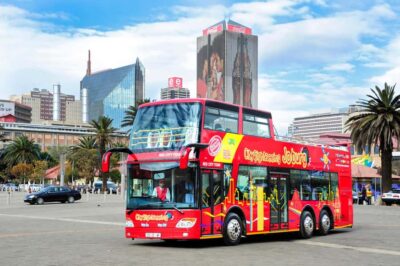

Soweto /Johannesburg and Apartheid Museum Guided Full Day Tour
Read our review →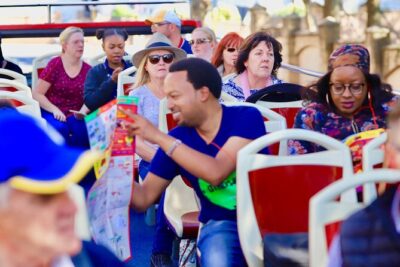
Johannesburg Hop-On Hop-Off City Tour with Soweto Option
Read our review →

Soweto: Walking Tour with a Local Guide and Lunch
Read our review →
Jo’berg in 1 Day: Soweto, Apartheid Museum & City Tour
Read our review →
Full-Day Tour with Soweto and Apartheid Museum
Read our review →
Browse the lists this tour appears in