
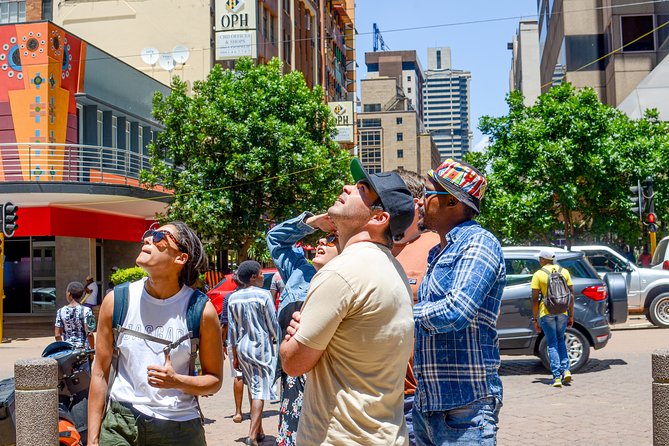
Reviewed · CITY TOURS
Johannesburg: City Centre Walking Tour
Johannesburg makes more sense on foot. This three-hour walk connects gold-mining history with the city’s present-day politics, architecture, art, and daily life. I like the route because it goes beyond the polished districts most visitors see, and I especially like the way local guides such as Refiloe, Thabo, Mathapelo, and Mulalo explain the city in plain, personal terms. The main drawback is that some stops, including the Workers Museum and Carlton Centre viewing areas, may not always be open or available.
You’ll walk through a part of Johannesburg that many people avoid without understanding it. Guides take care with the route and help you feel at ease, but this is still a working city centre, not a staged attraction. Comfortable shoes are essential, and you should be ready for changing streetscapes, serious history, street art, courts, offices, and plenty of questions.
In This Review
- Key points to know before you book
- Why a Johannesburg CBD walk is worth your time
- Gandhi Square and the first steps into the city
- Carlton Centre: an important stop with a possible limitation
- Courts, post offices, and the architecture of power
- Ferreirasdorp and the early diggings
- Chancellor House and Mandela’s legal work
- Newtown and the Workers Museum
- Mary Fitzgerald Square and Market Theatre
- Nelson Mandela Bridge and the route to Braamfontein
- The guides make the difference
- Safety, pace, and the practical side of walking
- Who should book this Johannesburg walk?
- My verdict: a strong introduction to the real city centre
- FAQ
- How long does the Johannesburg City Centre Walking Tour last?
- How much does the tour cost?
- Where does the tour begin?
- Where does the tour finish?
- Is hotel pickup included?
- Is lunch included?
- What language is the tour conducted in?
- Are entrance fees included?
- Is the tour suitable for wheelchair users?
- Can I cancel for a full refund?
Key points to know before you book

- Gold began the story: Main Street, Ferreirasdorp, and Marshalltown trace Johannesburg’s early mining origins.
- Mandela’s legal career comes alive: Chancellor House was home to the first black-owned law firm founded by Nelson Mandela and Oliver Tambo.
- The city’s present matters too: Your guide discusses safety, politics, housing pressures, and the changing condition of the CBD.
- Newtown adds art and working-class history: The Workers Museum, Mary Fitzgerald Square, and Market Theatre show another side of Johannesburg’s culture.
- The route ends with a skyline symbol: Nelson Mandela Bridge offers a memorable photo stop before the walk finishes in Braamfontein.
- Guides are a major strength: Refiloe is often praised for his warmth, humor, local insight, and willingness to answer questions.
Why a Johannesburg CBD walk is worth your time
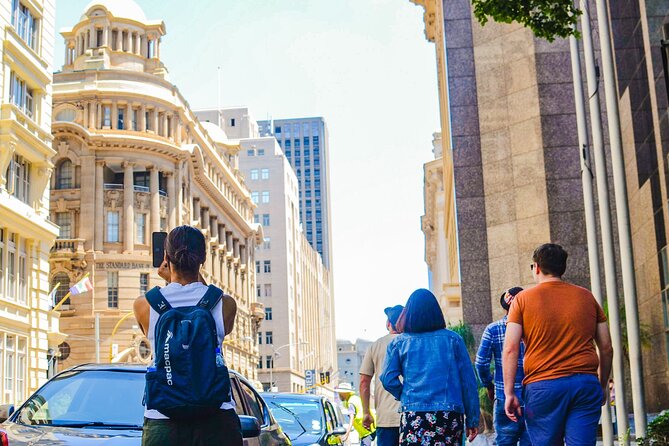
Johannesburg is easy to misunderstand from a car window. You can pass its high-rises, old post offices, courts, and broad avenues without seeing how mining, apartheid, migration, business, art, and urban decline fit together.
This tour gives you that missing context. It begins in Gandhi Square and moves north through the central business district, Ferreirasdorp, Newtown, and toward Braamfontein. The route is not only about famous names. It asks you to look at how people use the city now, and how older buildings have taken on new roles.
I particularly like the balance between grand architecture and ordinary city life. One moment you are looking at a major court or corporate office. The next, you are discussing migrant labor, street art, or the problems facing the CBD. The guide’s job is not simply to point at buildings. It is to help you understand why they matter.
The experience has earned a 4.8 rating from 152 ratings, and the praise centers on the same things: strong guides, a feeling of safety, useful historical context, and a more honest look at Johannesburg than you get from a quick sightseeing drive.
More City Tours in Johannesburg
- Johannesburg Hop-On Hop-Off City Tour with Soweto Option
★ 4.5 · 768 reviews - Jo’berg in 1 Day: Soweto, Apartheid Museum & City Tour
★ 4.8 · 524 reviews - Soweto: Hop-On Hop-Off Bus, City Tour and Apartheid Museum
★ 4.5 · 250 reviews
Gandhi Square and the first steps into the city
Meet your guide outside Nando’s at Gandhi Square, near the Metropolitan Building. This is a practical starting point because the square places you directly in the middle of Johannesburg’s old commercial core.
Your guide begins with the city’s gold-mining story and explains how Johannesburg grew from early diggings into a major South African city. From here, the walk gives you a sense of the CBD’s scale. Tall buildings, old civic structures, busy streets, and changing storefronts all share the same space.
The tone matters. This is not a glossy introduction that skips uncomfortable subjects. The discussion includes the city’s current condition and politics, so you should expect a frank account rather than a simple list of dates.
Carlton Centre: an important stop with a possible limitation
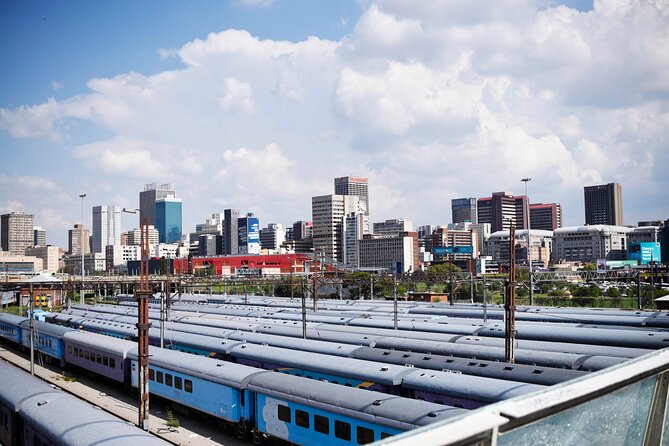
The Carlton Centre receives about 20 minutes of guided attention. It is one of the most recognizable parts of Johannesburg’s skyline and a useful point for discussing the city’s vertical growth.
The advertised route includes a visit, but access to the former high-level viewing area has changed. One guide explained that visitors were no longer being admitted to the 360-degree view, then offered another place to see the skyline. That is useful to know before you arrive: enjoy the building and its place in the city, but do not treat a panoramic lift ride as guaranteed.
This is one of the few areas where the experience may not match every expectation. The guide’s flexibility can help, but the route is strongest for its street-level explanation, not for a promised observation deck.
Courts, post offices, and the architecture of power
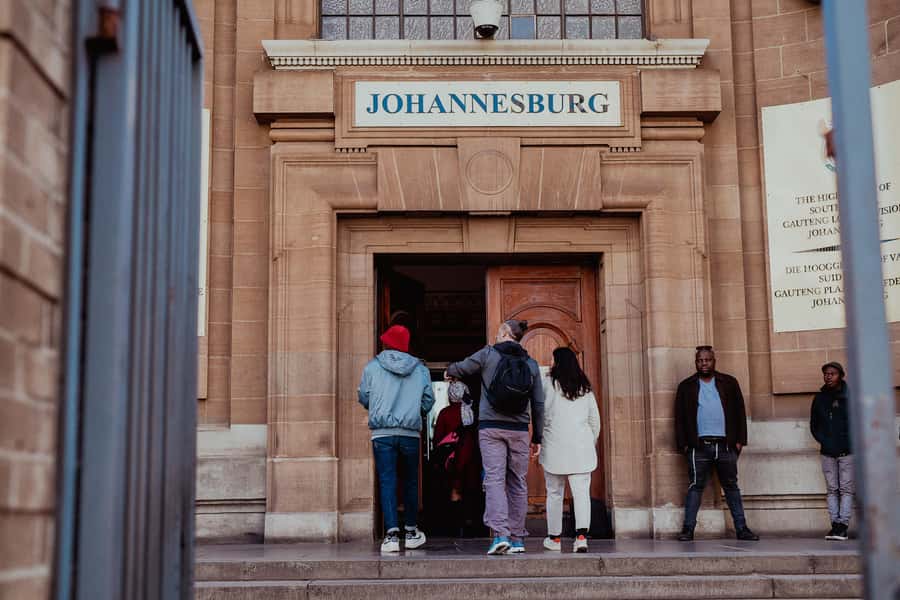
The walk continues past the High Court of South Africa, Gauteng Local Division. You spend about 20 minutes here, with time for photographs and an explanation of the building and its role in public life.
This stop works well because courts make the city’s political story tangible. You are not only hearing about law and government in the abstract. You are standing outside institutions that have shaped public decisions and South African history.
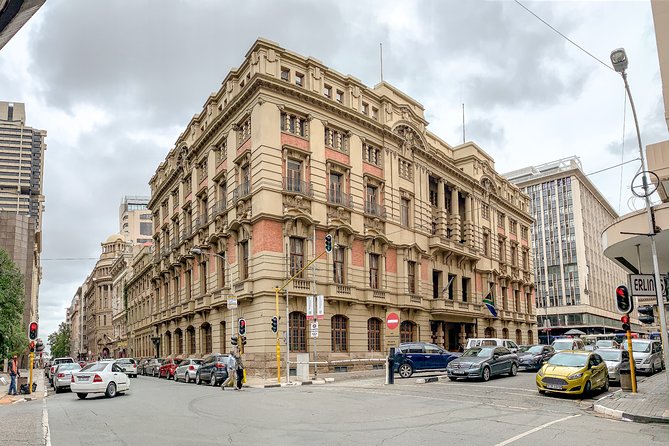
The Marshalltown Post Office receives around 10 minutes. It is a shorter stop, but it adds another piece to the old civic and commercial centre. After that comes Marshalltown itself, with approximately 30 minutes for walking, sightseeing, and photographs.
You might find this stretch more interesting if you enjoy architecture and urban details than if you want a string of famous attractions. The guide helps you notice what you could easily pass by on your own, including how older buildings sit beside newer uses and visible signs of urban change.
More Walking Tours in Johannesburg
- Soweto: Walking Tour with a Local Guide and Lunch
★ 4.9 · 648 reviews - Soweto Walking Tour with Lunch
★ 5.0 · 288 reviews - Johannesburg: Local Food Tasting Guided Walking Tour
★ 4.7 · 192 reviews - Johannesburg City Centre Walking Tour
★ 5.0 · 80 reviews
Ferreirasdorp and the early diggings
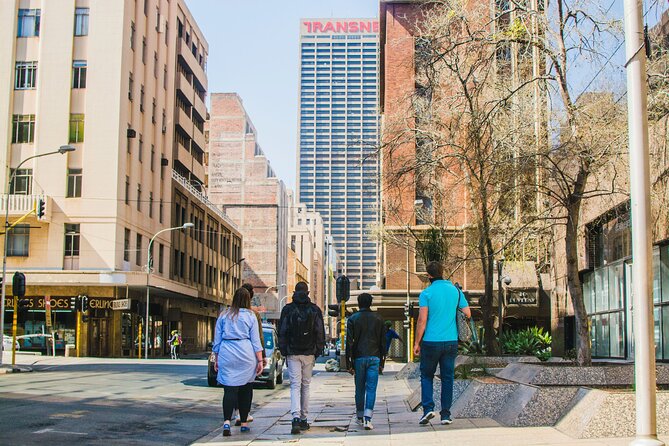
Ferreirasdorp is often called the cradle of Johannesburg because the first gold diggings began here and early diggers settled in the area.
This is one of the most valuable parts of the walk. Johannesburg can seem like a modern high-rise city, but Ferreirasdorp brings you back to its rough beginnings. The gold story is not treated as a distant museum subject. It explains why the city was founded where it was, why people arrived, and why Johannesburg became so important so quickly.
The route then moves through Beyers Naude Square, with about 20 minutes for sightseeing and photographs. You also pass the Anglo American corporate offices, where the guide can connect the early mining economy with the large companies that followed.
That contrast is worth noticing. The walk puts the origin of Johannesburg beside the institutions that grew from it. You see how the city’s wealth, work, and power have long been tied to mining.
Chancellor House and Mandela’s legal work
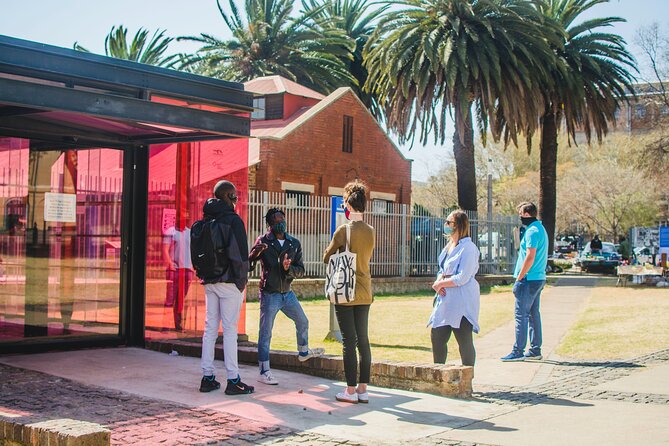
One of the key historical moments comes at Chancellor House, associated with Nelson Mandela and Oliver Tambo’s first black-owned law firm.
This stop gives the political story a human scale. Mandela is often presented only as a national leader, but here you learn about his work as a lawyer and his partnership with Tambo. The building helps connect the struggle for justice to a real office in the centre of Johannesburg.
The nearby Johannesburg Central Magistrate’s Court receives about 20 minutes of guided attention. That pairing is effective. Chancellor House represents legal work carried out by Mandela and Tambo, while the court represents the formal justice system around them.
You should expect discussion of apartheid and the legal and political pressures of the period. The guide’s explanation is especially helpful here because the buildings alone cannot tell you how important these places were.
Newtown and the Workers Museum
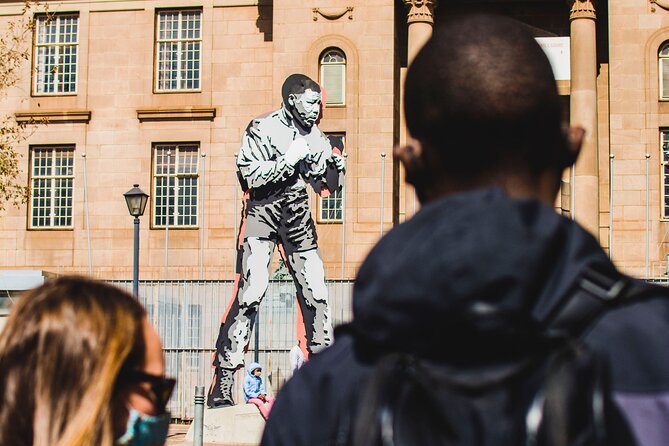
Newtown changes the mood of the walk. It is one of Johannesburg’s creative districts, with cultural venues, street art, galleries, and spaces connected to performance and music.
The Workers Museum is scheduled as a 15-minute stop. Its subject is migrant labor, one of the central forces that shaped Johannesburg and South Africa. The museum helps explain the lives and working conditions of people who came to the city for employment, often under harsh and restrictive systems.
There is one practical warning: the museum may be closed, particularly on Mondays. If that happens, the guide can still explain the migrant labor system and workers’ living conditions, but you will miss the indoor displays.
That possibility does not ruin the route, but it does affect what you receive. If the museum is a priority, check its opening status before booking or ask the operator about the day of your walk.
Mary Fitzgerald Square and Market Theatre
Mary Fitzgerald Square receives about 15 minutes. It is a useful place to pause and consider Newtown’s working-class and industrial past, as well as its cultural renewal.
The Market Theatre follows, with a shorter five-minute pass-by and explanation. The theatre is tied to Johannesburg’s cultural life and adds another layer to the Newtown section. Here, the tour moves from labor and industry toward performance, art, galleries, and public creativity.
You should not expect a long theatre visit. The Market Theatre is part of the walking route rather than a full performance or backstage experience. Still, the stop helps explain why Newtown matters beyond its buildings.
This is also a good section for people who like cities in transition. You will see places that carry older memories while supporting newer artistic uses. The guide helps tie those changes together instead of treating each stop as an isolated sight.
Nelson Mandela Bridge and the route to Braamfontein
Nelson Mandela Bridge is one of the walk’s best photo stops. You spend about 10 minutes here, with views along the way and a chance to see how the bridge links different parts of Johannesburg.
The bridge is more than a convenient final landmark. It serves as a visual connection between neighbourhoods with different identities, including Newtown and Braamfontein. After several hours of history, courts, labor, and culture, it gives you a clear sense of the city’s scale.
The tour finishes near Sha’p Braai, a shisanyama restaurant. Lunch is not included, but the ending gives you an option to continue with local food after the walk. One past participant especially praised the food, though you should plan and pay for it separately.
Braamfontein is known for youthful energy and an arts-focused culture. Ending here makes sense because the tour moves from Johannesburg’s mining origins to its current creative life.
The guides make the difference
The strongest part of this experience is the guiding. Refiloe is repeatedly praised for his command of Johannesburg’s past and present, his humor, and his care with guests. One private booking lasted four hours instead of the planned three because he wanted to cover more of the city.
That extra time should not be assumed, but it shows the kind of personal approach you may receive when the group is small. Other guides named in feedback include Thabo, Mathapelo, Mulalo, Clement, Tebogo, and Jerry. The comments about them are consistent: friendly, attentive, well informed, and able to explain the city without making the walk feel like a lecture.
Small groups or private departures can also make a difference. Several people ended up with a private walk and were able to ask many questions. If your booking is shared, the amount of personal discussion will depend on the group, but the route still provides a useful overview.
Safety, pace, and the practical side of walking
Safety is a common concern in Johannesburg’s CBD, and the guides receive strong praise for choosing routes carefully and helping people feel comfortable. That does not mean you should switch off your judgment. You are walking through an active urban area, so stay with the group and follow the guide’s advice.
The walk lasts three hours and includes repeated stops, photo pauses, and substantial time on foot. Wear supportive shoes, carry water, and dress for outdoor conditions. Bottled water and entrance fees are included, but lunch, hotel pickup, and hotel drop-off are not.
The activity is listed as wheelchair accessible, yet the practical information also says it is not suitable for wheelchair users. Those details conflict. If you use a wheelchair, contact the operator before paying and ask about the exact route, surfaces, buildings, and current access arrangements.
The walk is also marked as unsuitable for pregnant women. All other ages are welcome, provided you can manage a three-hour urban walking route.
At $40 per person, the value is good if you want context rather than a quick photo collection. You are paying for a guide, a planned route, water, and entry fees, but the real value is the explanation of places that can be difficult to interpret alone.
Who should book this Johannesburg walk?
I would choose this tour if you want to understand Johannesburg’s CBD rather than only see its polished shopping and hotel districts. It suits first-time visitors, history-minded people, architecture fans, and anyone curious about the city’s present-day challenges.
It also works well early in your stay. The route gives you a useful mental map of central Johannesburg, Newtown, and Braamfontein, and it may help you decide where to return for food, art, or another tour.
I would hesitate if you dislike long walks, prefer indoor attractions, or expect every scheduled building to be open. The Workers Museum can be closed, Carlton Centre access can change, and the route includes serious social and political discussion.
Book at least 24 hours ahead if you want the option of a full refund for cancellation. You can also reserve now and pay later, which helps if your schedule is still shifting. The tour runs in English with a live guide.
My verdict: a strong introduction to the real city centre
I recommend the Johannesburg City Centre Walking Tour for anyone who wants a grounded introduction to Jozi. Its best feature is not one single monument. It is the way the guide connects gold, law, apartheid, migrant labor, architecture, street culture, and present-day urban life in one walk.
Choose it for the stories and the street-level view. Just wear good shoes, keep your expectations flexible about indoor access, and confirm wheelchair suitability directly with One Day Africa if needed. If Refiloe, Mathapelo, Mulalo, or another experienced guide leads your walk, you are likely to get far more than a list of sights.
FAQ
How long does the Johannesburg City Centre Walking Tour last?
The scheduled duration is three hours. Some walks may last longer if the guide and group agree to continue, but extra time is not guaranteed.
How much does the tour cost?
The price is $40 per person.
Where does the tour begin?
Meet your guide outside Nando’s at Gandhi Square, in the Metropolitan Building area.
Where does the tour finish?
The walk finishes at Sha’p Braai, a shisanyama restaurant in the Braamfontein area.
Is hotel pickup included?
No. Hotel pickup and drop-off are not included.
Is lunch included?
No. Lunch is not included. The tour ends near Sha’p Braai, where you may choose to eat separately.
What language is the tour conducted in?
The live guided tour is conducted in English.
Are entrance fees included?
Yes. Entrance fees and bottled water are included in the tour price.
Is the tour suitable for wheelchair users?
The activity information says it is wheelchair accessible, but it also says the tour is not suitable for wheelchair users. Contact One Day Africa before booking to confirm the current route and access conditions.
Can I cancel for a full refund?
Yes. You can cancel up to 24 hours in advance for a full refund. You can also reserve now and pay later.
Newest reviews from Johannesburg
- Cradle of Humankind and Maropeng Day Tour from Johannesburg★ 4.0 · 5 reviews
- Explore Soweto 8 Hour Tour with Lunch and Museum Visit★ 5.0 · 5 reviews
- 3 Day All Incl. Private Kruger Park Safari Incl. Transfer From Johannesburg★ 5.0 · 5 reviews
- Harties cableway Tour★ 4.5 · 5 reviews
- Pretoria Historical Tour★ 4.0 · 5 reviews
- Constitutional Hill and Soweto 5 hours tour.★ 5.0 · 5 reviews
- 5 Day Kruger National Park and Panorama Route Safari★ 4.5 · 5 reviews
- Luxury Car Johannesburg Airport Private Transfer★ 5.0 · 5 reviews
City Tours, compared.
Cape Town Hop-On Hop-Off City Tour with Optional Cruise
Read our review →
Johannesburg Hop-On Hop-Off City Tour with Soweto Option
Read our review →
Jo’berg in 1 Day: Soweto, Apartheid Museum & City Tour
Read our review →
Cape Town City Pass: Save Over 50% on 80+ Top Attractions
Read our review →
Soweto: Hop-On Hop-Off Bus, City Tour and Apartheid Museum
Read our review →

Browse the lists this tour appears in