
Reviewed · CITY TOURS
Pretoria City Tour
History comes alive in Pretoria. This private half-day outing from Johannesburg links South Africa’s Boer, apartheid, and democratic past through major landmarks, with time for both guided visits and city views. I especially like the private transport and the chance to shape the conversation around your interests. The main drawback is that the $108.52 price excludes admission fees, and four to five hours can feel tight at the biggest sites.
The tour works best for you if Pretoria is your first introduction to South African political history. Guides such as Lesiba and Martin have earned praise for clear explanations, warm service, and the ability to adjust the discussion, including for visitors interested in Afrikaans culture and the Anglo-Boer War. Freedom Park and the Voortrekker Monument give the day its emotional weight, but Pretoria itself may not charm everyone visually.
In This Review
- Key points before you book
- Why Pretoria belongs on a Johannesburg itinerary
- The Voortrekker Monument and the Great Trek
- The former presidential residence and a curious building detail
- Church Square, the old heart of Pretoria
- A glimpse of UNISA and Pretoria’s academic identity
- Fountains Valley and the first reserves
- The Union Buildings and modern South African power
- Freedom Park, where the tour turns solemn
- The guide is the real value
- Timing, comfort, and who should book
- Should you book the Pretoria City Tour?
- FAQ
- Where does the Pretoria City Tour take place?
- How long does the tour last?
- What is included in the tour price?
- Are admission fees included?
- Is this a private tour?
- Can I cancel for a full refund?
Key points before you book
- The Voortrekker Monument opens with pioneer history: Plan on about one hour for the guided account of the Great Trek and Afrikaner settlement.
- Freedom Park is the longest and most reflective stop: Its two-hour visit covers memorials to those killed in South Africa’s wars and during apartheid.
- The Union Buildings provide the strongest photo stop: You’ll see the official seat of government and the large Nelson Mandela statue.
- This is a private tour: Only your own group participates, with an air-conditioned vehicle, bottled water, and private transport.
- The guide makes a major difference: Lesiba and Martin are praised for history, cultural context, communication, and tailoring the day to individual interests.
- Budget beyond the tour fee: Admission charges are not included, and lunch or a single drink is available only as an addition to the full-day version.
Why Pretoria belongs on a Johannesburg itinerary
Pretoria, also called Tshwane, is South Africa’s administrative capital. Cape Town handles the legislature, and Bloemfontein is the judicial capital, but Pretoria is where the national government and foreign embassies are based.
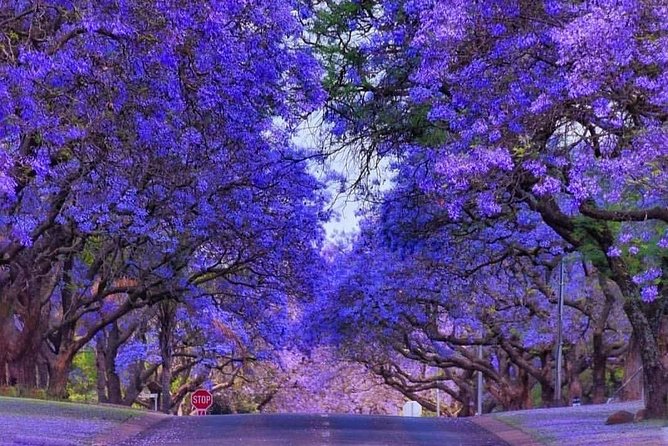
That gives the city a different feel from Johannesburg. The focus here is government, education, monuments, and the long argument over who belongs in the national story. Pretoria is also known as Jacaranda City, a nod to the trees that turn much of the city purple in spring.
You won’t get a broad tour of every part of Pretoria in four or five hours. Instead, you’ll visit a chain of places that explain how the city grew from a Boer settlement into the administrative center of modern South Africa. The route moves from Afrikaner migration to government power, then toward a wider memorial account of freedom and human rights.
I find that progression useful. It does not reduce Pretoria to pretty streets and government buildings. It asks you to look at the country’s past from several angles, though the quality of that experience depends heavily on the guide’s skill.
The private format helps. You are not tied to a large group’s pace or a fixed conversation. Lesiba has been praised for explaining the role of Afrikaans in South African history, while Martin has been described as friendly, patient, and willing to take initiative. If you want to focus on a particular subject, raise it early.
More City Tours in Johannesburg
- Johannesburg Hop-On Hop-Off City Tour with Soweto Option
★ 4.5 · 768 reviews - Jo’berg in 1 Day: Soweto, Apartheid Museum & City Tour
★ 4.8 · 524 reviews - Soweto: Hop-On Hop-Off Bus, City Tour and Apartheid Museum
★ 4.5 · 250 reviews
The Voortrekker Monument and the Great Trek
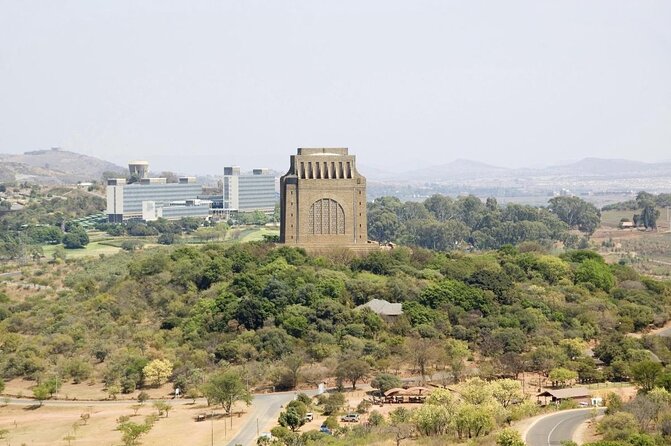
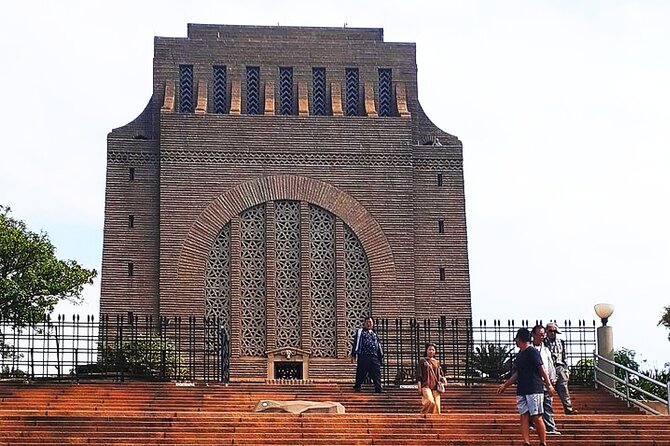
The Voortrekker Monument is the tour’s most distinctive first stop. It presents the story of the Voortrekkers, Boer pioneers who moved inland from the Cape during the 1830s and 1840s. The guided visit focuses on the history of pioneers moving from the Cape toward the interior, with the year 1836 or 1837 marking the period at the center of the story.
Allow about one hour here. Admission is not included, so check the current entry charge when you book or before departure. That extra cost matters because the monument is not simply a quick exterior photo stop. The value comes from hearing the story explained while you are inside a place designed to honor the Voortrekker experience.
This is also where a balanced guide matters most. The monument reflects an Afrikaner interpretation of the past, including migration, conflict, and settlement. It can be powerful, but it is not a complete account of South African history by itself. Lesiba has received particular praise for discussing Boer history and the development of Afrikaans in a thoughtful, even-handed way.
If that subject interests you, tell the guide. One of the strongest features of a private tour is the ability to spend more time on the questions that matter to you instead of listening to a one-size-fits-all speech.
I would treat this as the intellectual anchor of the morning. The building and its historical message give you a frame for later stops. At the same time, you should expect a serious historical visit rather than a light sightseeing attraction. Some people may find the monument’s viewpoint narrow if they want a fuller treatment of colonialism, African resistance, and the later political changes. That is a reason to ask questions, not a reason to skip it.
The former presidential residence and a curious building detail
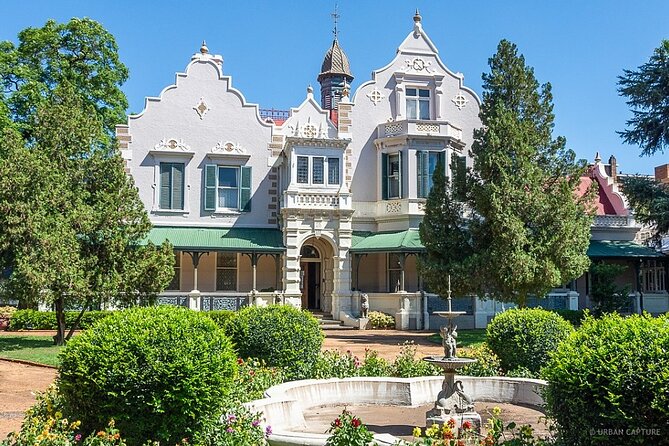
The route also includes the former presidential residence, described as the first house in Pretoria to receive electricity. The home contains original furnishings or pieces from the same period, giving you a more domestic look at political life.
A small construction detail adds personality. Milk was used instead of water in the cement mixture because the available cement was poor quality. It is the kind of practical fact that can turn a short stop into a memorable one.
The supplied schedule does not assign a separate duration to this visit, so expect it to fit around the main stops rather than receive a long formal tour. That is worth keeping in mind if historic interiors are your main interest. The house adds useful texture, but the Voortrekker Monument and Freedom Park receive the clearest time commitments.
Church Square, the old heart of Pretoria
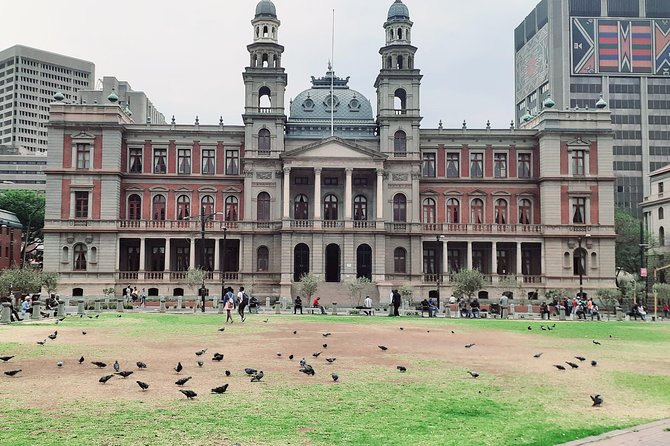
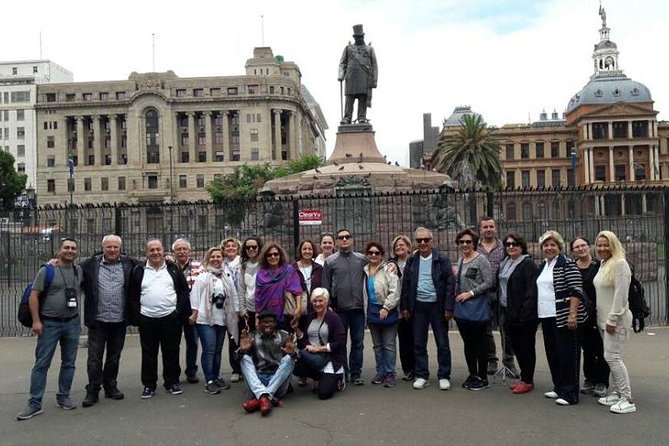
Church Square is the historic center of Pretoria. Marthinus Pretorius, the city’s founder, designated it as a market and church yard. Its name comes from church buildings that occupied the middle of the square between 1856 and 1905.
You have about 30 minutes here, and there is no admission charge. This is a quick orientation stop, not a museum visit. Use the time to look at the surrounding civic buildings, absorb the layout of the old center, and let the guide explain how Pretoria developed around this public space.
Church Square helps connect the monuments to an actual city. After the large symbolic scale of the Voortrekker Monument, the square gives you a more ordinary urban setting. You can see how public religion, commerce, and government once shared the same central ground.
Thirty minutes is enough for an overview, but not enough for a slow architectural study. If you like wandering, shopping, or lingering over city details, you may wish the schedule allowed more time. The benefit is that the tour keeps moving and leaves room for Union Buildings and Freedom Park.
A few more tours worth putting side by side
- From Johannesburg: Pilanesberg Nature Reserve Game Safari
★ 4.8 · 1,327 reviews - Johannesburg: Hop-On Hop-Off Bus with Optional Soweto Tour
★ 4.6 · 985 reviews - Soweto /Johannesburg and Apartheid Museum Guided Full Day Tour
★ 5.0 · 932 reviews - Full Day Ultimate Pilanesberg National Park Safari from Johannesburg or Pretoria
★ 4.5 · 718 reviews
A glimpse of UNISA and Pretoria’s academic identity
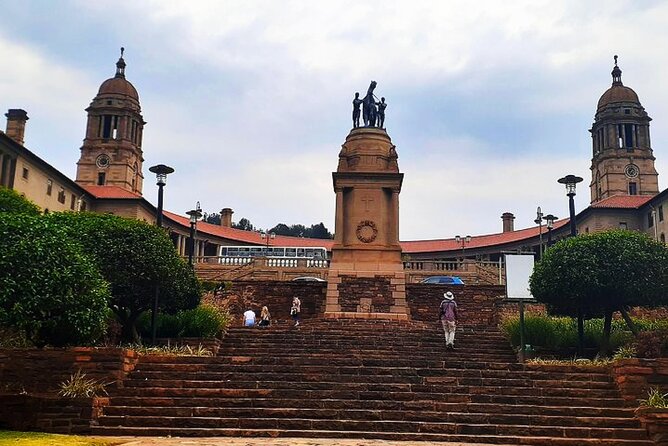
Pretoria is also an academic city. It has three universities, along with the Council for Scientific and Industrial Research and the Human Sciences Research Council. One of the places connected with that identity is the University of South Africa, usually called UNISA.
UNISA began in 1873 as the University of the Cape of Good Hope. It later served as an examining agency for Oxford and Cambridge before taking on a new role as a distance education university in 1946. Today it has more than 300,000 students, including students from about 130 countries.
The itinerary information does not give UNISA a dedicated stop length, so you should understand this as part of the city orientation rather than a campus tour. Still, it adds an important layer to Pretoria. This is not only a capital of ministries and monuments. It is also a major center for higher education and research.
I appreciate this sort of context because it prevents the day from becoming a parade of government symbols. You get a glimpse of the institutions that shape the city’s present, not just its past.
Fountains Valley and the first reserves
Another point connected with Pretoria’s early development is Fountains Valley, a recreational resort at the southern entrance to the city. The area was proclaimed a nature reserve by President Paul Kruger in 1895. Together with nearby Groenkloof Nature Reserve, it forms part of what is described as the oldest nature reserve system on the African continent.
The Apies River runs through the resort, and natural water sources are found in the area. Facilities include a caravan park, swimming pool, lapa, playground, and barbecue areas. Near the resort are the ruins of the house of Lucas Cornelius Bronkhorst, whose family was part of Hendrik Potgieter’s Great Trek party and among the first owners of farms in the district where Pretoria later developed.
Again, no separate visit length is provided. You should not book this experience expecting an extended nature excursion or a walk through the reserve. Its value lies in showing the early setting and development of Pretoria, linking natural resources with settlement.
This stop also gives the historical story a physical setting. The city did not appear in isolation. Rivers, farms, routes, and water sources helped determine where people lived and how the capital grew.
The Union Buildings and modern South African power
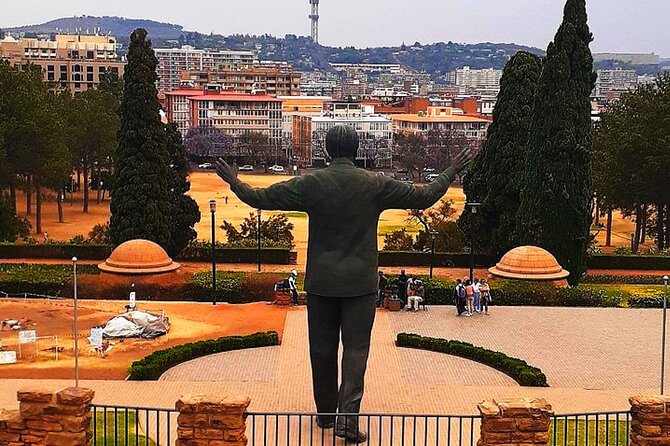
The Union Buildings are the grandest civic stop of the day. They occupy the highest point of Pretoria, on Meintjieskop at the northern end of Arcadia, and serve as the official seat of the South African government. The President’s offices are here as well.
The light sandstone buildings were designed by Sir Herbert Baker. You have about 45 minutes, with no admission charge. That is enough to take in the setting, hear the political background, and photograph the exterior, though it is not an interior government tour.
The site carries two kinds of meaning. Architecturally, it represents the confidence and authority of the Union-era government. Politically, it remains a working national symbol in democratic South Africa. The juxtaposition is important. You are looking at a place tied to older systems of power, but also to the country as it exists today.
The Nelson Mandela statue is a particularly moving feature for many people. One visit described finding it emotional, which makes sense: the statue changes the feel of the formal government precinct. It brings the story from institutions and conflict toward reconciliation, leadership, and democratic change.
For me, this is likely the easiest stop to enjoy even if you are not a dedicated history fan. The views from the high ground, the sandstone architecture, the gardens, and the political importance all work together. The only limitation is time. Forty-five minutes passes quickly, especially if you want photographs and a careful explanation.
Freedom Park, where the tour turns solemn
Freedom Park is a heritage site and museum on Salvokop Hill. Its memorial spaces are linked by the themes of freedom and human rights. The site honors people who fought for freedom and human rights in South Africa.
This is the longest scheduled visit, at about two hours, and admission is not included. Plan for another fee and for a more serious pace than at Church Square or the Union Buildings.
The memorial includes names of people killed in the South African Wars, the First and Second World Wars, and the apartheid era. That broad range is central to the site’s purpose. It places conflicts that are often treated separately into one national story, while also recognizing the human cost behind political change.
The stop can be moving and memorable. One guide, Martin, was praised for making the visit enjoyable while handling Freedom Park’s solemn subject with care. That balance is useful. The park is not a quick monument photo, and it is not designed as entertainment. Give yourself time to read, listen, and think.
Freedom Park may be the most important stop for understanding how South Africa remembers its past. It also provides a counterweight to the Voortrekker Monument. The two sites do not tell the same story, and seeing both lets you compare different ways of presenting identity, sacrifice, and national belonging.
If you prefer a fast-moving city tour, two hours here may feel long. If you want historical context, it is the time well spent. Ask the guide to explain the different memorial sections and the conflicts they represent. The private setting makes it easier to pause when something needs clarification.
The guide is the real value
The fee is $108.52 per person. That is not a cheap add-on, especially because admission charges, meals, and taxes are excluded. But the comparison is not simply between this price and a self-guided drive around Pretoria.
You are paying for private transportation from the Johannesburg area, an air-conditioned vehicle, bottled water, and a guide who can interpret complicated history. For a solo participant or a couple, the cost is substantial. For a small group, the private format and group discounts can make the calculation more favorable.
The tour is booked an average of 38 days ahead, so it is sensible to reserve early if your schedule is fixed. Confirmation is normally provided at booking. Reservations made within 12 hours of departure are subject to availability and may be confirmed as soon as possible.
The strongest value comes from the guide. Lesiba has been praised for extensive historical knowledge, a calm manner, and the ability to tailor the day to an interest in Afrikaans history. Martin has been praised for being informative, friendly, patient, and proactive. Communication before pickup has also been a positive feature, with one guide contacting the party several days ahead to confirm arrangements.
That personal attention is why I would choose this over a bare sightseeing transfer. Pretoria’s monuments carry political weight, and a good explanation helps you notice what a building or memorial is trying to say.
Timing, comfort, and who should book
The tour lasts roughly four to five hours. That is a useful length if you are based in Johannesburg and want a focused introduction without giving up a full day. It is also short enough to combine with other plans, though Freedom Park and the Voortrekker Monument make the schedule more substantial than a simple drive-by tour.
Pickup is offered, and the vehicle is air-conditioned. Bottled water is included. A mobile ticket makes the booking easy to carry, and service animals are allowed. The tour operates near public transportation, although the main arrangement is private transport.
Most people can participate according to the provided information. Still, remember that this is a history-heavy outing with several stops and a two-hour visit at Freedom Park. If you need a slower pace, ask about timing before booking.
This experience suits:
- First-time visitors to Pretoria who want the main political and historical sights.
- Couples and small groups who prefer a private vehicle.
- Anyone interested in Afrikaans history, the Great Trek, or the Anglo-Boer War.
- Visitors who want a guide to explain apartheid-era memory and democratic South Africa.
- People using Johannesburg as a base who have only half a day.
It is less suited to you if your priority is shopping, food, nightlife, or a relaxed nature outing. Pretoria may not strike you as beautiful in every section, and the schedule gives only limited time for wandering. The tour is about understanding the city more than falling in love with every street.
You can cancel free of charge up to 24 hours before the start time for a full refund. Cancellations or changes made less than 24 hours ahead are not accepted for a refund, and cut-off times follow local time.
Should you book the Pretoria City Tour?
Book it if you want a guided explanation of Pretoria’s competing historical stories, not just a checklist of buildings. The Voortrekker Monument, Union Buildings, and Freedom Park make a strong sequence, and the private format lets you ask direct questions.
I would book especially if you can request Lesiba or Martin, or at least tell the company what interests you before pickup. That preparation can turn a standard city outing into a focused lesson on Afrikaans identity, government, apartheid, or national memorials.
Think twice if $108.52 per person feels high once admission fees are added, or if you want a slow, scenic day. For everyone else, this is a practical and serious introduction to Pretoria, with a guide-led approach that gives the city far more meaning than a quick independent drive past the sights.
FAQ
Where does the Pretoria City Tour take place?
The tour is based in Pretoria, also called Tshwane, and pickup is offered from the Johannesburg area.
How long does the tour last?
The experience lasts approximately four to five hours.
What is included in the tour price?
The price includes an air-conditioned vehicle, private transportation, and bottled water.
Are admission fees included?
No. Admission fees and taxes are not included. The Voortrekker Monument and Freedom Park specifically list admission as an additional cost.
Is this a private tour?
Yes. Only your own group participates in the activity.
Can I cancel for a full refund?
Yes. You can cancel at least 24 hours before the local start time for a full refund. Changes or cancellations made less than 24 hours before departure are not accepted for a refund.
Newest reviews from Johannesburg
- Cradle of Humankind and Maropeng Day Tour from Johannesburg★ 4.0 · 5 reviews
- Explore Soweto 8 Hour Tour with Lunch and Museum Visit★ 5.0 · 5 reviews
- 3 Day All Incl. Private Kruger Park Safari Incl. Transfer From Johannesburg★ 5.0 · 5 reviews
- Harties cableway Tour★ 4.5 · 5 reviews
- Pretoria Historical Tour★ 4.0 · 5 reviews
- Constitutional Hill and Soweto 5 hours tour.★ 5.0 · 5 reviews
- 5 Day Kruger National Park and Panorama Route Safari★ 4.5 · 5 reviews
- Luxury Car Johannesburg Airport Private Transfer★ 5.0 · 5 reviews
City Tours, compared.
Cape Town Hop-On Hop-Off City Tour with Optional Cruise
Read our review →
Johannesburg Hop-On Hop-Off City Tour with Soweto Option
Read our review →
Jo’berg in 1 Day: Soweto, Apartheid Museum & City Tour
Read our review →
Cape Town City Pass: Save Over 50% on 80+ Top Attractions
Read our review →
Soweto: Hop-On Hop-Off Bus, City Tour and Apartheid Museum
Read our review →

Browse the lists this tour appears in