
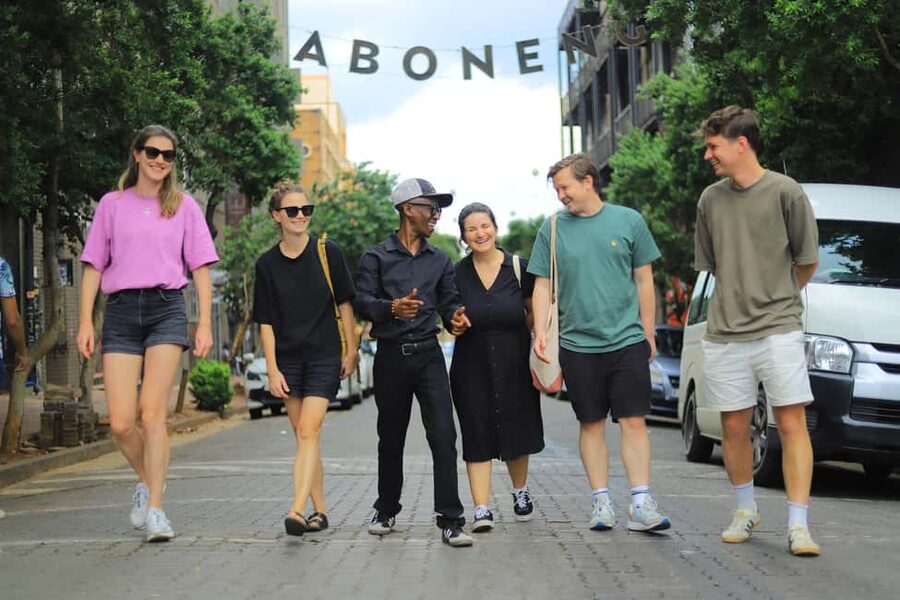
Reviewed · JOHANNESBURG TOURS
Johannesburg: The Evolution of Maboneng (Place of Light)
Cities can change block by block. Maboneng makes that change visible through street art and creative renewal, while the walk also brings you to old Johannesburg buildings, Arts on Main, and the Kwa Mai-Mai traditional healers’ market. I especially like the strong sense of place and the chance to see urban regeneration up close. The guides, including Tsepho and Eko, have been praised for explaining the neighborhood’s past and present in a clear, personal way.
The main drawback is value. At $42 per person, this is not a cheap city walk, and the experience can feel more like a guided stroll than a full tour if several planned stops are missed. The market visit, in particular, may not happen every time, so I would confirm the exact route before booking.
In This Review
- Key things to know about the Maboneng walk
- Why Maboneng makes a good first Johannesburg walk
- Meeting at Curiocity Backpackers on Fox Street
- The Cosmopolitan and Johannesburg’s early suburbs
- Drive-lines and the practical side of regeneration
- Murals that turn walls into meeting points
- Arts on Main and The Centre for the Less Good Idea
- Kwa Mai-Mai and the traditional healers’ market
- The Collectors Treasure and the final skyline view
- What the $42 price really buys you
- Who will enjoy this experience most
- Practical advice before you go
- Should you book The Evolution of Maboneng?
- FAQ
- How long is The Evolution of Maboneng tour?
- Where does the tour begin?
- Where does the tour end?
- What language is the tour conducted in?
- What should I bring?
- Is the tour suitable for people with limited mobility?
- Is the tour suitable for pregnant women?
- Can I cancel for a full refund?
Key things to know about the Maboneng walk
- Maboneng means Place of Light: The name reflects the district’s effort to turn former industrial and neglected spaces into places for art, food, housing, and small business.
- The tour begins at Curiocity Backpackers: You meet at 302 Fox Street in Jeppestown before setting off on foot through the eastern side of downtown Johannesburg.
- Public art is central to the experience: Murals by local and international artists, including work associated with Nelson Makamo, are treated as part of the neighborhood’s public story.
- Old and new Johannesburg meet here: The route includes the 1899 Cosmopolitan building and the newer Drive-lines development, made with upcycled shipping containers.
- Arts on Main adds a cultural stop: This former industrial setting is linked with artist William Kentridge and The Centre for the Less Good Idea.
- The tour ends where it starts: Plan on two hours of walking, comfortable shoes, weather-appropriate clothing, and enough energy for uneven city streets.
Why Maboneng makes a good first Johannesburg walk
Maboneng is a useful introduction to Johannesburg because it does not present the city as frozen in the past. You see old commercial buildings, new housing ideas, street murals, traditional medicine, galleries, and bookshops within a relatively compact area.
The name Maboneng comes from seSotho and means Place of Light. That phrase fits the district’s stated aim, but it is also worth keeping your expectations grounded. This is not a polished open-air museum. It is a working urban neighborhood shaped by redevelopment, artistic projects, business investment, and the complications that come with change.
That tension gives the walk its value. You are not only looking at painted walls. You are learning how entrepreneurs and artists have helped change part of Johannesburg’s inner city, and how public art can make streets feel more welcoming and connected.
I would choose this experience early in a Johannesburg visit if you want context before exploring on your own. A guide can point out details you might otherwise walk past, especially architectural features, murals, and the links between different parts of the district.
A few more tours worth putting side by side
- From Johannesburg: Pilanesberg Nature Reserve Game Safari
★ 4.8 · 1,327 reviews - Johannesburg: Hop-On Hop-Off Bus with Optional Soweto Tour
★ 4.6 · 985 reviews - Soweto /Johannesburg and Apartheid Museum Guided Full Day Tour
★ 5.0 · 932 reviews
Meeting at Curiocity Backpackers on Fox Street
The walk starts at Curiocity Backpackers, at 302 Fox Street in Jeppestown. This gives the tour a practical base in the neighborhood rather than beginning at a distant transport hub or a generic city landmark.
The meeting point is also part of the district’s modern identity. Curiocity is associated with the newer creative and social side of Johannesburg, so the start helps set the tone before you head into the streets.
The experience is conducted in English and lasts two hours. Since it is entirely on foot, you should wear shoes that can handle a steady city walk. Weather-appropriate clothing matters too, since much of the experience takes place outdoors.
The route is not recommended for people with limited mobility, and it is not suitable for pregnant women. That is not a minor footnote: the experience depends on walking between several locations, with no promise of a vehicle transfer when a stop is farther away.
The Cosmopolitan and Johannesburg’s early suburbs
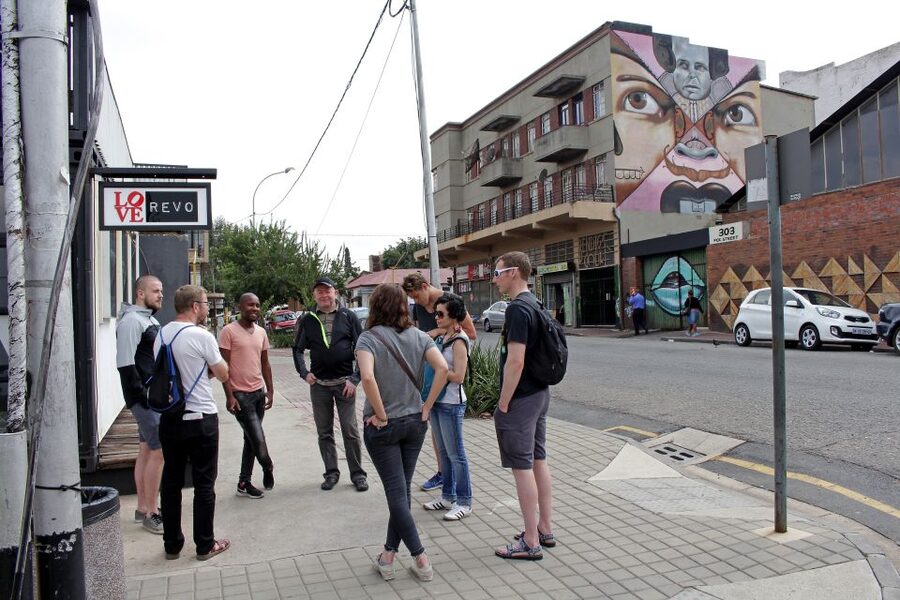
One of the most useful parts of the walk is the attention given to Johannesburg’s first suburbs and older buildings. The Cosmopolitan is a particularly good example.
Built in 1899, the building opened as a hotel and bar in 1902. Its elegant heritage architecture gives you a glimpse of a much earlier Johannesburg, when the city was still taking shape around mining wealth and new commercial activity.
The point is not simply to admire an old facade. Your guide connects the building to the lives and businesses that once occupied the city center. The Cosmopolitan becomes a reminder that Maboneng’s present-day creative energy is only the latest chapter in a long urban story.
This stop should appeal to anyone who likes architecture with a little character. You do not need to be an architectural expert. The guide’s job is to explain why the building matters and help you notice the details that make it more than another old structure.
The limitation is time. A two-hour walk can only offer a short look at each stop, so do not expect a full architectural tour or an interior visit at every landmark.
Drive-lines and the practical side of regeneration
The Drive-lines development shows a different side of Maboneng. It uses upcycled shipping containers as affordable housing, turning an industrial object into part of a residential project.
This is one of the clearest examples of the entrepreneurial spirit behind the neighborhood’s renewal. You can see how regeneration is not only about restoring grand historic buildings. It can also involve low-cost materials, creative design, and new ways to use limited urban space.
For me, this is where the tour’s title becomes most useful. The Evolution of Maboneng is not just a story about brighter paint and new cafes. It is also about practical experiments in housing and development.
At the same time, a guided visit helps you ask sensible questions. Who benefits from redevelopment? How affordable is affordable housing? What happens to long-term residents and older businesses when an area becomes fashionable? The supplied information does not answer all of those questions, and the tour should not be treated as a complete study of Johannesburg’s housing issues.
Still, it gives you a starting point. You see one project and hear how the district’s transformation is described from within the neighborhood.
A completely different kind of day out on the same trip:
- Johannesburg Hop-On Hop-Off City Tour with Soweto Option
★ 4.5 · 768 reviews - Full Day Ultimate Pilanesberg National Park Safari from Johannesburg or Pretoria
★ 4.5 · 718 reviews - Half-Day Tour of Soweto Tour
★ 4.5 · 712 reviews - Soweto: Walking Tour with a Local Guide and Lunch
★ 4.9 · 648 reviews
Murals that turn walls into meeting points
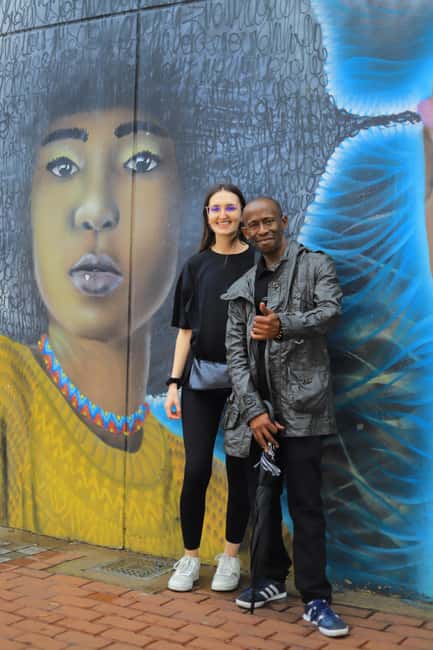
Street art is one of the strongest reasons to book this walk. The murals are not treated as random decoration. They are presented as a way to soften barriers between people and make public space feel shared.
A major highlight is the Mandela mural, along with murals associated with Nelson Makamo. The public art collection is described as an open-air museum, though the city streets remain the setting, with all the unpredictability that comes with an outdoor route.
This part of the walk is especially good for photographers and anyone interested in how art changes a neighborhood’s mood. A guide can also give you a better sense of the difference between a mural made by a local artist and one created by an international name.
Do not expect every mural to be in perfect condition. Outdoor art changes with weather, construction, and daily use. That is part of the point: the art belongs to the streets, rather than sitting behind glass.
The quality of guiding matters here. Tsepho, also spelled Tsehpo in the available information, received praise for explaining the area and opening access to places with rooftop views and strong street-art displays. Eko was also praised for explaining Maboneng’s origins and history. Since the experience depends heavily on the guide’s storytelling, this is an area where your experience may vary.
Arts on Main and The Centre for the Less Good Idea
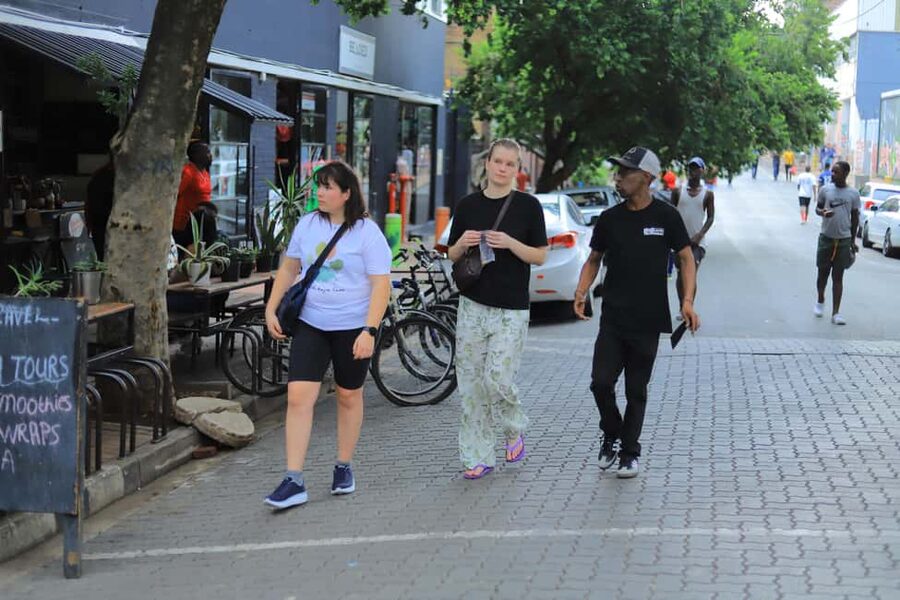
Arts on Main adds an important cultural stop to the route. It is linked with South Africa’s celebrated artist William Kentridge and is now also associated with his foundation, The Centre for the Less Good Idea.
That name suggests an artistic approach built around experimentation rather than polished commercial results. Even a short visit helps show why Maboneng attracted artists and creative groups in the first place.
I like this stop because it broadens the tour beyond murals. Street art gives you a quick visual hit, while Arts on Main points toward longer-term creative work, exhibitions, studios, and cultural projects.
The experience may not include a full guided gallery visit or a meeting with artists. The exact amount of time available can depend on the pace of the walk and what is open during the visit. If Arts on Main is the main reason you are booking, ask ahead about what you will actually see on the day.
Kwa Mai-Mai and the traditional healers’ market
The Kwa Mai-Mai Traditional Healers’ Market is described as one of the oldest traditional healers’ markets in Johannesburg. It is meant to introduce you to sangomas, traditional medicines, and traditional clothing.
This is a meaningful contrast with Maboneng’s galleries and design projects. You are seeing a part of Johannesburg that is tied to living cultural practice, not simply a restored building or an art installation.
Approach this stop with respect and curiosity. A market connected with traditional healing is not a themed attraction created for sightseeing. Your guide should help you understand what you are seeing without turning people’s beliefs and work into a spectacle.
There is an important practical warning here. The market visit may not occur on every walk. One account of the experience specifically noted that there was no market visit, despite it being part of the expected route. I would ask Curiocity whether Kwa Mai-Mai is planned for your date, especially if this is your top priority.
The Collectors Treasure and the final skyline view
Book lovers have another reason to consider the tour: The Collectors Treasure, described as the largest second-hand bookstore in the southern hemisphere.
That is a bold claim, but the appeal is easy to understand. A large used-book shop offers a different way to read a city’s cultural life. You may find shelves that reflect South Africa’s past, changing interests, and the odd pleasures of browsing without a shopping list.
The stop also gives the tour a relaxed finish. You can browse if time allows, then possibly end with a sundowner overlooking the Johannesburg skyline. The skyline view is not guaranteed as a long, formal stop, since the schedule depends on time.
This is where the two-hour limit becomes noticeable. Maboneng offers more than the walk can cover. If your group pauses for photographs, spends time at the market, or has a long conversation with the guide, one of the final stops may receive less attention.
What the $42 price really buys you
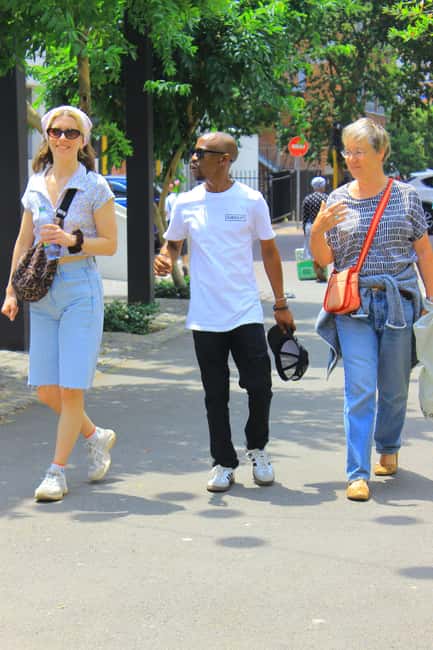
At $42 per person, this is a premium price for a two-hour walking tour. You are paying primarily for local interpretation, route planning, and a safer, more structured way to see a part of Johannesburg that some visitors may not feel comfortable exploring alone.
The best value comes when your guide is engaged and the route includes several of the advertised cultural stops. Strong guiding can connect the Cosmopolitan, Drive-lines, the murals, Arts on Main, Kwa Mai-Mai, and The Collectors Treasure into one clear story about change.
The weaker value appears when the experience becomes only a walk through the streets. One assessment described the price as too high because the activity felt more like a stroll than a full tour. Another account noted that the walk ended about 20 minutes early, which would make the price harder to justify.
Before you pay, decide what you need. If you want a short orientation with local context, the fee may be reasonable. If you expect entry to several venues, extensive time at the market, artist meetings, or a long rooftop stop, you may leave disappointed.
The reserve-now, pay-later option can help if your Johannesburg schedule is still changing. Cancellation is allowed up to 24 hours in advance for a full refund, which reduces the risk of booking early.
Who will enjoy this experience most
I would recommend the walk to you if you enjoy cities as works in progress. It suits people who like public art, architecture, urban planning, independent businesses, and conversations about how neighborhoods change.
It is also a good choice for a first Johannesburg visit, particularly if you want a guided introduction to the eastern side of the downtown area. Several guides have been praised for explaining Maboneng’s origins and giving useful local insight.
You will get the most from it if you ask questions. Ask how the district has changed, what the older buildings were used for, how public art is supported, and whether the market and rooftop stop are included that day.
I would hesitate to recommend it if you have limited mobility, are pregnant, or dislike walking outdoors. I would also be cautious if your main goal is a guaranteed traditional market visit or a meeting with artists.
Practical advice before you go
Wear comfortable shoes and clothing suited to the weather. The activity is a walking tour, not a coach excursion, so you should be prepared to remain outdoors for much of the two hours.
Meet at Curiocity Backpackers and expect to return to the same point. Do not litter, and treat the market, artists, residents, and businesses with basic respect.
Because the route may change, confirm the day’s stops before setting out. This is particularly important for Kwa Mai-Mai, Arts on Main, the rooftop view, and The Collectors Treasure.
Keep your schedule flexible after the tour. If the walk finishes early, you may want time to revisit a favorite mural, browse the bookshop, or explore a venue you saw along the route.
Should you book The Evolution of Maboneng?
Book this tour if you want a guided introduction to Maboneng’s art and redevelopment, and you value local explanation more than a long list of included admissions. The strongest version of the experience gives you old architecture, container housing, major murals, creative spaces, traditional culture, and a skyline view in one compact walk.
At $42, I would book only after confirming the route and accepting that the guide will shape much of the experience. The area is interesting enough to justify the visit, but the price feels fair only when the guide is engaged and the walk runs close to its full two hours.
FAQ
How long is The Evolution of Maboneng tour?
The guided walking tour lasts two hours.
Where does the tour begin?
It begins at Curiocity Backpackers, 302 Fox Street, Jeppestown, Johannesburg, 2043, South Africa.
Where does the tour end?
The activity ends back at the same meeting point.
What language is the tour conducted in?
The tour is conducted in English.
What should I bring?
Bring comfortable shoes and clothing suited to the weather.
Is the tour suitable for people with limited mobility?
No. The tour is not recommended for people with limited mobility or mobility impairments.
Is the tour suitable for pregnant women?
No. The experience is listed as unsuitable for pregnant women.
Can I cancel for a full refund?
Yes. You can cancel up to 24 hours in advance for a full refund.
Newest reviews from Johannesburg
- Cradle of Humankind and Maropeng Day Tour from Johannesburg★ 4.0 · 5 reviews
- Explore Soweto 8 Hour Tour with Lunch and Museum Visit★ 5.0 · 5 reviews
- 3 Day All Incl. Private Kruger Park Safari Incl. Transfer From Johannesburg★ 5.0 · 5 reviews
- Harties cableway Tour★ 4.5 · 5 reviews
- Pretoria Historical Tour★ 4.0 · 5 reviews
- Constitutional Hill and Soweto 5 hours tour.★ 5.0 · 5 reviews
- 5 Day Kruger National Park and Panorama Route Safari★ 4.5 · 5 reviews
- Luxury Car Johannesburg Airport Private Transfer★ 5.0 · 5 reviews
Johannesburg Tours, compared.


Soweto /Johannesburg and Apartheid Museum Guided Full Day Tour
Read our review →
Johannesburg Hop-On Hop-Off City Tour with Soweto Option
Read our review →
Full Day Ultimate Pilanesberg National Park Safari from Johannesburg or Pretoria
Read our review →

Soweto: Walking Tour with a Local Guide and Lunch
Read our review →
Jo’berg in 1 Day: Soweto, Apartheid Museum & City Tour
Read our review →Browse the lists this tour appears in